
The Rise of Robo-Advisors: How AI is Transforming Investment Management
Introduction:
Robo-advisors have emerged as a powerful force in the world of investment management, harnessing the capabilities of artificial intelligence (AI) to revolutionize how individuals and institutions manage their finances. This article explores the rise of robo-advisors and their transformative impact on the investment landscape. We will delve into the benefits they offer, their underlying AI technology, and how they are reshaping the way people approach investing. Discover the exciting world of robo-advisors and learn how AI is democratizing investment management for a wider audience.
What are Robo-Advisors?
Robo-advisors are digital platforms that leverage AI algorithms to provide automated investment advice and portfolio management services. They use sophisticated algorithms and mathematical models to assess an individual’s risk tolerance, financial goals, and time horizon. Based on this information, they recommend suitable investment strategies and create diversified portfolios.

Image Source: cdn.leadpilot.io
How Robo-Advisors Work?
Robo-advisors utilize AI algorithms to streamline the investment process. Investors typically start by answering a series of questions about their financial situation, investment goals, and risk preferences. The robo-advisor then employs these inputs to create a personalized investment plan. The algorithms consider factors such as asset allocation, diversification, and tax efficiency while constructing the portfolio.
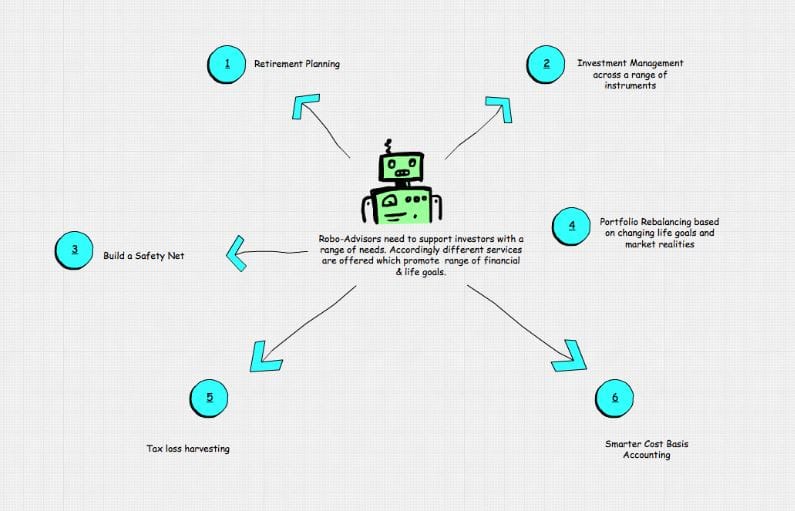
Image Source: vamsitalkstech.com
Once the portfolio is established, robo-advisors continually monitor the market and the client’s financial situation. They automatically rebalance the portfolio to maintain the desired asset allocation and make adjustments as per changing market conditions. Some robo-advisors even offer tax-loss harvesting, a technique that aims to minimize taxes by selling investments at a loss to offset gains.
Advantages of Robo-Advisors
a. Accessibility: Robo-advisors have democratized investment management by providing affordable access to professional investment services. They have lowered the barriers to entry, allowing individuals with limited capital to invest in diversified portfolios that were once only available to wealthier investors.
b. Cost-Effectiveness: Traditional investment management services often involve high fees, making them inaccessible for many investors. Robo-advisors, on the other hand, typically charge lower fees due to their automated nature. This cost-effectiveness ensures that investors retain a higher proportion of their investment returns.
c. Personalized Portfolios: Robo-advisors offer personalized investment portfolios tailored to individual needs and risk profiles. By analyzing vast amounts of data and using sophisticated algorithms, they can create portfolios that align with specific investment objectives, such as long-term growth, income generation, or capital preservation.
d. Transparency: Robo-advisors provide transparency in their investment strategies and fees, ensuring that investors have a clear understanding of how their money is being managed. The algorithms used by robo-advisors are often rule-based, eliminating human bias and emotional decision-making.
e. Time Efficiency: Robo-advisors automate investment processes, saving investors significant time and effort. Clients can easily access their investment accounts, monitor performance, and make changes through user-friendly digital platforms.
AI Technology behind Robo-Advisors
Robo-advisors rely on AI technology to process vast amounts of financial data, generate investment recommendations, and manage portfolios. Machine learning algorithms power these platforms, enabling them to learn and improve from historical data and market trends.
AI algorithms analyze various factors, including historical asset performance, economic indicators, and investor behavior, to make informed investment decisions. Natural language processing (NLP) capabilities allow to understand and interpret unstructured data from news articles, social media, and financial reports, enabling them to adjust portfolios based on relevant market information.
Additionally, AI-powered risk assessment models help robo-advisor determine an individual’s risk tolerance by considering multiple variables, such as age, income, investment goals, and time horizon. This ensures that the investment strategy aligns with the investor’s risk preferences.
The Future of Robo-Advisors
Robo advisors are likely to continue evolving as AI technology advances. As AI algorithms become more sophisticated will enhance their ability to analyze complex market dynamics and make more accurate predictions. This will lead to further personalized investment recommendations and improved risk management strategies.

Image Source: agendainvest.com
Moreover, robo advisors may integrate other emerging technologies, such as blockchain, to enhance security, transparency, and efficiency in investment transactions. They may also incorporate features like goal-based planning and financial education to provide comprehensive financial services to users.
Conclusion
Robo advisors have ushered in a new era of investment management, leveraging AI technology to provide accessible, cost-effective, and personalized investment solutions. These platforms have democratized investing by making professional investment advice available to a wider audience. With their transparent approach, robust algorithms, and time-saving benefits are transforming the way people approach investing. As AI continues to advance, the future of robo advisors looks promising, promising further innovation and improved investment outcomes for individuals and institutions alike.
FAQs
Q1. What is the role of AI in a robo-advisor?
AI plays a crucial role in robo-advisors by leveraging advanced algorithms and machine learning to automate investment processes, analyze data, and generate personalized investment recommendations.
Q2. What is the rise of robo advisory?
The rise of robo-advisory refers to the increasing popularity and adoption of digital platforms that use AI algorithms to provide automated investment advice and portfolio management services.
Q3. Are robo-advisors good for investing?
Yes, robo-advisors can be a good option for investing as they provide accessible, cost-effective, and personalized investment services using AI algorithms. They offer diversified portfolios, automation of investment processes, and transparency, making them a convenient choice for individuals looking to grow their wealth with professional guidance.
Q4. How does automated investing work?
Automated investing, also known as robo-investing, works by using computer algorithms and AI technology to automatically manage investment portfolios. Investors provide their financial goals and risk tolerance, and the algorithms analyze data to create and rebalance portfolios accordingly, saving investors time and effort in managing their investments.
Q5. Why are robo-advisors becoming more popular?
Robo-advisors are becoming more popular due to their accessibility, cost-effectiveness, and ability to provide personalized investment solutions. They offer affordable access to professional investment services, lower fees compared to traditional advisors, and create tailored portfolios based on individual goals and risk tolerance.
Also read How to Get a Fast Loan From OneMain Financial

Muskan Bansal is a finance enthusiast with a keen interest in financial news and sports. With a passion for staying up-to-date with the latest developments in the world of finance, Muskan combines a strong analytical mindset with a love for sports to gain a well-rounded perspective. Equipped with a deep understanding of both domains, Muskan seeks to bridge the gap between finance and sports, exploring the intersection of these two diverse fields.