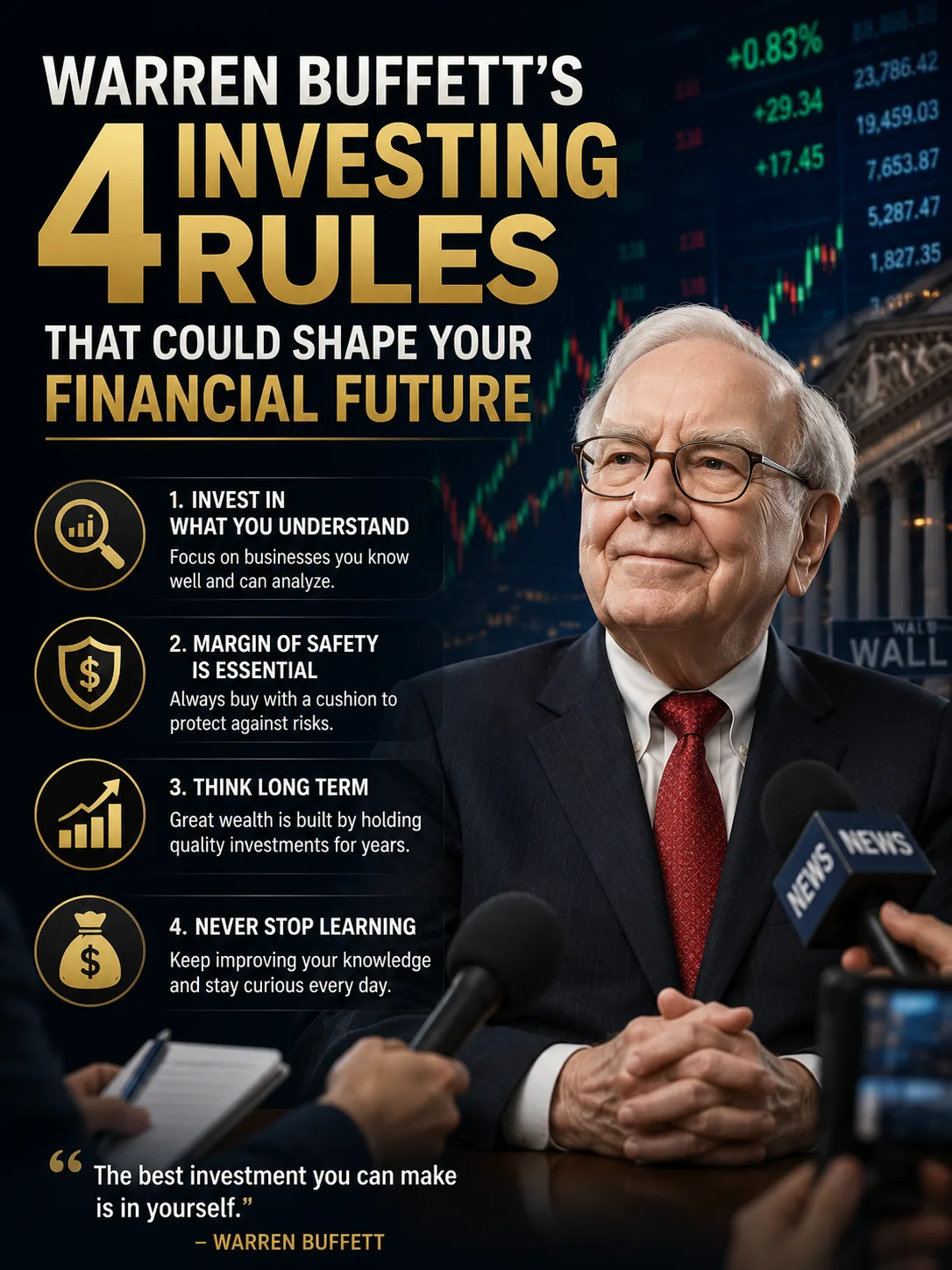
Warren Buffett’s 4 Investing Rules That Could Shape Your Financial Future

4 Investing Rules

The investing world has changed dramatically over the past decade. Artificial intelligence is reshaping industries, social media influencers are sharing stock tips daily, and millions of first-time investors can buy shares with just a few taps on their smartphones. Despite all these changes, one investor’s advice continues to stand the test of time—Warren Buffett. Often called the “Oracle of Omaha,” Buffett has spent over six decades proving that successful investing isn’t about chasing trends or predicting the next hot stock. Instead, it’s about making rational decisions, understanding businesses, and allowing time to work in your favor. Recently, Investopedia highlighted four timeless investing lessons Buffett believes every young investor should understand before entering the market. While these principles may seem simple, they’ve helped build one of the most successful investing careers in history and continue to influence investors across the globe. Let’s take a closer look at the four rules that could shape your financial future. Why Warren Buffett’s Advice Still Matters When Warren Buffett speaks, the investment community pays attention—and for good reason. As the Chairman and CEO of Berkshire Hathaway, Buffett transformed a struggling textile business into one of the world’s largest conglomerates through disciplined investing. His long-term approach has consistently outperformed many market cycles, making him one of the most trusted voices in finance. His annual shareholder letters are studied by professional investors, business leaders, and finance students because they focus on principles rather than predictions. Instead of trying to forecast the next market rally or crash, Buffett teaches investors how to make smarter decisions regardless of market conditions. 1. Invest in Yourself Before Investing in the Market According to Buffett, the most valuable investment you’ll ever make isn’t a stock—it’s yourself. Learning new skills, improving financial knowledge, understanding businesses, and developing better decision-making abilities can generate returns for a lifetime. Markets rise and fall, but the knowledge you gain continues to benefit you throughout your career and investing journey. This principle is especially important today, when investment advice is everywhere. Rather than relying solely on trending videos or social media opinions, Buffett encourages investors to build their own understanding of how businesses and markets work. “The best investment you can make is an investment in yourself.” That single idea has become one of the foundations of Buffett’s investing philosophy. 2. Only Invest in Businesses You Truly Understand One of the biggest mistakes new investors make is buying stocks simply because they’re popular. Whether it’s artificial intelligence, electric vehicles, renewable energy, or the latest technology trend, excitement alone shouldn’t determine an investment decision. Buffett believes investors should stay within their “circle of competence”—meaning they should only invest in businesses they genuinely understand. Ask yourself: If those questions are difficult to answer, it may be worth spending more time researching before investing. Understanding the business often matters more than following the crowd. 3. Think in Years, Not Days Modern markets encourage short-term thinking. Stock prices update every second, financial news never stops, and social media celebrates overnight gains. Buffett takes a completely different approach. Instead of focusing on daily price movements, he encourages investors to think like business owners rather than traders. A quality company should be evaluated based on its long-term ability to create value—not on what its share price does this week. History has repeatedly shown that patient investors often outperform those who constantly buy and sell based on short-term emotions. This long-term mindset has been one of the biggest reasons behind Buffett’s extraordinary success. 4. Don’t Let Market Volatility Control Your Decisions Every investor experiences periods of uncertainty. Markets fall. Economic conditions change. Interest rates rise. Geopolitical events create volatility. For many people, these moments trigger panic. Buffett sees them differently. Instead of viewing market corrections as disasters, he believes they often create opportunities to buy strong businesses at more attractive prices. His famous advice perfectly captures this mindset: “Be fearful when others are greedy and greedy when others are fearful.” Rather than reacting emotionally to market headlines, Buffett encourages investors to stay focused on the long-term value of the businesses they own. Why These Four Rules Are More Relevant Than Ever Today’s investors have access to more information than ever before. Unfortunately, they also face more distractions. Trending stocks, viral investment tips, AI speculation, and constant market updates can make investing feel overwhelming. Buffett’s philosophy cuts through that noise. His advice isn’t built around predicting the next winning stock or timing the market perfectly. Instead, it focuses on habits that remain valuable regardless of economic conditions. Whether markets are booming or correcting, these four principles continue to provide a practical framework for making better investment decisions. What Trusted Financial Sources Say Several respected financial organizations continue to reinforce Buffett’s investing philosophy. Investopedia recently revisited Buffett’s guidance for first-time investors, emphasizing the importance of self-education, investing within your circle of competence, maintaining a long-term outlook, and avoiding emotional decision-making. Similarly, Berkshire Hathaway’s annual shareholder letters consistently highlight capital discipline, business quality, and patience as the foundations of successful investing. Financial media such as CNBC has also frequently covered Buffett’s belief that market volatility should be viewed as an opportunity rather than a reason to panic. The consistency of these messages across multiple trusted sources explains why Buffett’s principles remain relevant to both new and experienced investors. Final Thoughts There will always be another market trend, another technological breakthrough, and another stock that captures investors’ attention. But successful investing has never been about chasing every opportunity. Warren Buffett’s greatest lesson isn’t teaching people how to predict markets—it’s teaching them how to think. By investing in yourself, understanding the businesses you own, staying patient, and keeping a long-term perspective, you build habits that can serve you through every stage of your investing journey. These rules may not promise overnight success, but they offer something far more valuable: a disciplined approach that has stood the test of time. Enjoyed this article? Follow DailyTopStocks for more expert-backed investing insights, stock market analysis, and easy-to-understand financial content that helps you … Read more

₹2 Lakh Crore Gone in a Day: How Accenture Triggered an IT Sector Meltdown

Accenture

The Indian stock market witnessed one of the biggest shocks of 2026 when IT stocks plunged sharply, wiping out nearly ₹2 lakh crore in market value in a single trading session. The trigger? A disappointing earnings outlook from global IT services giant Accenture. What started as a weak earnings update from a U.S.-based company quickly turned into a sector-wide selloff across India’s leading IT firms, including TCS, Infosys, Wipro, HCLTech, and Tech Mahindra. But was the panic justified? And did investors really lose ₹2 trillion overnight? Let’s break down what actually happened. What Happened? On June 19, 2026, Accenture released its latest quarterly results and lowered its revenue growth forecast for FY2026. The company reduced its expected growth range to 3%-4%, down from its earlier guidance of 3%-5%. It also reported weaker-than-expected bookings and highlighted cautious client spending trends. Adding to investor concerns, Accenture revealed that geopolitical disruptions in the Middle East could impact revenue by approximately $400 million. While these numbers may seem specific to Accenture, investors viewed them as a warning sign for the entire global IT services industry. Why Did Indian IT Stocks Fall So Hard? Accenture is widely considered a barometer for global technology spending. When the company signals weaker demand, investors often assume similar challenges could affect Indian IT service providers. As a result, heavy selling was seen across major Indian IT stocks: The Nifty IT index recorded one of its steepest single-day falls of the year as investors rushed to reduce exposure to the sector. Did Investors Really Lose ₹2 Lakh Crore? Yes and no. The widely reported ₹2 lakh crore figure refers to market capitalization erosion, not actual cash losses. Market capitalization represents the combined value of listed companies based on their stock prices. When share prices fall, the market value of those companies decreases. This does not mean investors physically withdrew ₹2 lakh crore from the market. Instead, it reflects the reduction in the overall valuation of listed IT companies. Several financial reports estimated the loss between ₹1.35 lakh crore and ₹2 lakh crore, depending on which companies and indices were included in the calculation. For more detailed insights, you can read the full article on Times of India. The Bigger Concerns Behind the Selloff Accenture‘s earnings were only the trigger. Several underlying concerns were already weighing on the IT sector. 1. AI Disruption Fears Artificial Intelligence continues to transform the technology industry. Investors worry that AI-driven automation could reduce demand for traditional outsourcing services, which have long been a major revenue source for Indian IT companies. While AI creates new opportunities, many investors remain uncertain about how quickly these companies can adapt their business models. 2. Weak Global Technology Spending Many businesses worldwide are still cautious about spending on large-scale digital transformation projects. Companies are prioritizing essential investments while delaying discretionary technology spending. This directly impacts revenue growth for IT service providers. 3. Slower Outsourcing Demand Accenture‘s weaker bookings suggest that clients are taking longer to approve major outsourcing contracts. For Indian IT firms, which rely heavily on long-term service agreements, this trend is particularly concerning. 4. Geopolitical Uncertainty Global conflicts and economic uncertainty continue to affect business confidence. Companies often delay technology investments during uncertain periods, creating additional pressure on the IT services industry. What Are Analysts Saying? Several major brokerage firms expressed caution following Accenture‘s results. Key concerns include: Many analysts believe investors should closely monitor upcoming quarterly results before making major investment decisions. Is This a Buying Opportunity? That depends on your investment horizon. Short-term investors may continue to face volatility as markets digest concerns around AI, global spending, and earnings growth. However, long-term investors are watching for: Historically, leading Indian IT companies have successfully navigated multiple industry disruptions, but investors should remain selective and focus on business fundamentals. What Investors Should Watch Next The next few months could determine the direction of the IT sector. Key developments to monitor include: These indicators will provide a clearer picture of whether the recent selloff was an overreaction or a sign of deeper challenges ahead. Final Thoughts The headline claiming that investors lost ₹2 lakh crore is broadly accurate from a market capitalization perspective, but it doesn’t represent actual money leaving investors’ bank accounts. The selloff was triggered by Accenture‘s weaker outlook, but broader concerns around AI disruption, slowing outsourcing demand, cautious technology spending, and geopolitical uncertainty played equally important roles. For now, investors should focus less on sensational headlines and more on upcoming earnings, deal pipelines, and long-term industry trends. Want to stay ahead of the market? Don’t miss our Daily Top Stock Picks blog, where we cover trending stocks, major market moves, expert insights, and opportunities investors should watch every day. FAQ’s 1. Why did Indian IT stocks crash after Accenture’s earnings report? Indian IT stocks fell sharply after Accenture lowered its FY2026 revenue growth forecast and reported weaker-than-expected bookings. Investors viewed this as a sign of slowing global demand for IT services, triggering a sector-wide selloff. 2. Did investors really lose ₹2 lakh crore in one day?The ₹2 lakh crore figure refers to market capitalization erosion, not actual cash losses. It represents the decline in the combined market value of listed IT companies due to falling stock prices. 3. Which Indian IT stocks were most affected by the selloff?Major IT companies including TCS, Infosys, Wipro, HCLTech, and Tech Mahindra witnessed significant declines as investors reacted to concerns about global technology spending and outsourcing demand. 4. Is the recent IT sector crash linked to Artificial Intelligence (AI)?Partly. Investors are concerned that AI-driven automation could reduce demand for traditional outsourcing services. However, AI is also creating new opportunities for IT companies that successfully adapt to changing client needs. 5. What concerns did Accenture highlight in its earnings report?Accenture pointed to weaker bookings, cautious client spending, slower outsourcing demand, and geopolitical disruptions that could affect future revenue growth. 6. Is this a good time to invest in IT stocks?Investment decisions depend on individual goals and risk tolerance. Long-term investors … Read more

Reliance Industries AGM 2026 Signals the Future: Jio IPO, AI Infrastructure, and Digital India Expansion

Reliance Industries

Reliance Industries’ 49th Annual General Meeting on June 19, 2026 was not your typical shareholder gathering. It was a window into how Mukesh Ambani sees India’s digital economy taking shape over the next decade. The announcements covered ground that went well beyond quarterly numbers — from the long-awaited Jio IPO to sovereign AI infrastructure, satellite broadband, and serious commitments to education, healthcare, renewable energy, and domestic manufacturing. Taken together, the roadmap Reliance laid out points in one clear direction: the company is moving well beyond its roots as an energy and telecom giant and is actively building itself into a technology-driven ecosystem that touches nearly every corner of Indian life. Jio IPO Takes Center Stage The announcement that dominated the room was the approval and filing of the Draft Red Herring Prospectus for Jio Platforms’ Initial Public Offering. Mukesh Ambani confirmed that Jio Platforms has officially entered the listing process — a milestone that the market has been anticipating for years. Reports suggest the IPO could raise somewhere in the range of $3.8 to $4 billion, which would put it among the largest public offerings in Indian history. Jio Platforms currently counts over 500 million subscribers and holds a commanding share of India’s mobile data traffic — numbers that give this listing a scale few companies anywhere in the world can match. Why this matters beyond the headline figure: Analysts watching the space believe this listing has the potential to become a defining moment for India’s digital economy — one that draws sustained domestic and international investor attention long after the IPO itself closes. Reliance’s Big Bet on Artificial Intelligence If the Jio IPO was the headline, artificial intelligence was the underlying story running through nearly everything else announced at AGM 2026. Reliance Indutries confirmed that its AI initiative — operating under the name Reliance Intelligence — has moved from planning into active execution. The infrastructure centerpiece is being built in Jamnagar, Gujarat, and the platform is being designed to support AI services across 22 Indian languages. The practical goal behind that language coverage is significant: making AI genuinely usable for the hundreds of millions of Indians who do not operate primarily in English. Specific AI initiatives announced on the day: The thread running through all of these is a deliberate effort to reduce India’s dependence on foreign AI platforms while making the technology genuinely affordable and accessible at scale — not just for large enterprises but for small businesses, students, and everyday users. Satellite Broadband and the Push for Rural Connectivity Connectivity was the third major pillar of the AGM, and the announcement here had real practical implications for parts of India that fiber networks have not yet reached. Akash Ambani outlined a dual-track satellite strategy — partnering with established global satellite providers in the near term while simultaneously developing India’s own ground infrastructure and working toward indigenous satellite capabilities over time. The goal is straightforward: bring high-speed internet to underserved and remote regions where laying traditional cable is either too expensive or simply not feasible. What satellite broadband actually unlocks in these regions: The move puts Reliance in direct competition with global satellite internet providers for what could become one of the most contested connectivity markets of the next decade. Building India’s AI and Data Center Infrastructure Reliance Industries long-term strategy goes beyond telecom services. The company is investing heavily in AI infrastructure, cloud computing, and data center capacity. Reports indicate that Jamnagar is becoming the centerpiece of Reliance’s future digital infrastructure strategy, combining AI processing, cloud services, and advanced computing capabilities. As AI adoption accelerates across industries, data centers are expected to become critical infrastructure assets similar to highways, airports, and power grids. Reliance appears determined to establish itself as one of the primary providers of India’s digital backbone. Growth Plans Across the Business While Jio and AI took up most of the oxygen in the room, Reliance also laid out growth plans across several other parts of the business that deserve attention. Reliance Retail Retail plans include expanding domestic manufacturing in apparel and affordable consumer electronics while continuing to strengthen Reliance’s position as the country’s largest retailer. Growth is expected from both physical store networks and digital commerce channels as the two increasingly operate as a single integrated experience. Renewable Energy Reliance reaffirmed its clean energy commitments with specific projects already underway or in development: The scale of these commitments puts Reliance among the most serious corporate players in India’s energy transition — a transition that is accelerating as both policy pressure and economic logic push industry away from fossil fuels. Education and Healthcare Nita Ambani announced a series of social infrastructure investments that extend Reliance’s footprint well beyond commercial activity: These are not small gestures. At the scale Reliance operates, investments like these have real potential to shape access to quality education and healthcare for meaningful numbers of people over the coming years. What These Announcements Mean for India Step back from the individual announcements and a broader picture comes into focus. Reliance is not simply expanding its business — it is positioning itself as a primary builder of the infrastructure India’s next growth cycle will run on. The investments across AI, satellite communications, digital infrastructure, renewable energy, education, healthcare, and manufacturing line up closely with national priorities that have been articulated at the government level: If even a substantial portion of what was announced at AGM 2026 is delivered on schedule and at the promised scale, the impact on how ordinary Indians access technology, education, healthcare, and economic opportunity over the next ten years could be significant. Final Thoughts Reliance AGM 2026 may be remembered as a turning point in the company’s evolution. While the Jio IPO captured most of the attention, the bigger story was Reliance’s attempt to build a comprehensive technology ecosystem that spans AI, connectivity, cloud infrastructure, satellite communications, clean energy, and digital services. For investors, businesses, and consumers, the announcements suggest that Reliance is positioning itself not just as … Read more

Global Markets Jump After US-Iran Move Toward Ending Conflict: Why Investors Are Betting on a New Era of Stability

Global Markets

Global markets rallied strongly after reports emerged that the United States and Iran are moving toward ending months of conflict in the Gulf region. Investors responded positively to news of a proposed 14-point Islamabad Memorandum, which could pave the way for greater geopolitical stability and smoother global trade flows. Key Highlights of the Islamabad Memorandum The proposed framework is not a final peace agreement but serves as a roadmap toward de-escalation. The main points include: Even though the agreement remains in its early stages, markets reacted positively to the possibility of reduced tensions. Why the Strait of Hormuz Matters The Strait of Hormuz remains one of the world’s most critical energy corridors. Key Facts: As confidence grew that shipping would resume normally, traders quickly reduced the geopolitical risk premium built into oil prices. Markets React Positively Global equity markets posted significant gains: United States Markets US futures also reflected strong investor optimism: Oil Prices Fall Sharply Energy markets reacted in the opposite direction as geopolitical concerns eased. Crude Oil Performance Important Context Despite the decline: Sectors Benefiting from Lower Oil Prices Lower crude oil prices typically benefit industries that rely heavily on fuel and transportation costs. The biggest beneficiaries include: At the same time, energy producers may face pressure as lower oil prices can impact their profitability. This shift often leads investors to rotate funds from energy stocks into sectors that benefit from cheaper operating costs. What This Means for India India stands to gain significantly from any sustained decline in oil prices. As a country that imports more than 80% of its crude oil requirements, lower energy costs can have a meaningful impact on economic growth, inflation, and market sentiment. Equity Market Performance Currency Market Several sectors led the rally, including: Stocks such as Tata Motors, Maruti Suzuki, Larsen & Toubro, and Bajaj Finance emerged among the top gainers as investors positioned themselves for a potentially more favorable economic environment. Long-Term Benefits for India If the agreement progresses successfully and oil prices remain stable, India could experience several long-term advantages: Historically, Indian equity markets have performed well during periods of stable or declining crude oil prices, as lower energy costs improve margins and support economic growth. Why Investors Should Remain Cautious Despite the optimism, several uncertainties remain. The memorandum is only the first step toward a broader agreement, and previous diplomatic efforts have often faced delays or setbacks. Additionally, the physical normalization of shipping routes and energy supplies could take several months even if a formal agreement is reached. Market participants should also remember that geopolitical situations can change rapidly, and any disruption to negotiations could quickly reverse current sentiment. Conclusion The proposed US-Iran framework has injected fresh optimism into global financial markets, with investors betting that diplomacy will reduce geopolitical risks and stabilize energy supplies. The potential reopening of the Strait of Hormuz has already pushed oil prices lower and boosted equities worldwide. For India, the development could prove especially beneficial through lower inflation, reduced import costs, stronger currency performance, and renewed foreign investment. While risks remain and the agreement is far from complete, markets are clearly signaling their preference for stability over conflict, making this one of the most closely watched geopolitical developments of the year. FAQ’s Has the US-Iran war actually ended, or is this just talk? The conflict has moved beyond diplomatic discussions, with both countries reportedly signing a memorandum of understanding on June 17. The agreement includes a ceasefire, reopening of the Strait of Hormuz, and a commitment to negotiate a broader settlement covering Iran’s nuclear program and US sanctions within 60 days. While this is a significant step forward, a final peace agreement has not yet been reached   Will oil prices keep falling from here?Not necessarily. While oil prices have fallen following the agreement, analysts remain divided on the outlook. Supply chain disruptions, lower global inventories, and the time required to restore normal exports could keep oil prices elevated in the near term.   Will this bring inflation down everywhere, including India? Lower oil prices could help reduce inflationary pressure, but the impact may not be immediate. In India, cheaper crude oil would support the rupee, reduce import costs, and ease inflation over time, though broader economic factors will also influence price trends.  Which sectors and stocks stand to gain the most?  Sectors that benefit from lower fuel and transportation costs are expected to be the biggest winners. These include aviation, automobiles, logistics, banking, financial services, real estate, and metals. In India, stocks from these sectors have already responded positively to the easing geopolitical tensions. Kishan Rajawatdailytopstocks.in/

12 फीसदी तक शेयर में गिरावट, 45 हजार करोड़ रुपये इकट्ठा करने की योजना भी काफी नहीं: Vodafone Idea

शेयर

कंपनी ने घोषणा की है कि वह इक्विटी या इक्विटी-संबंधित उपकरणों के माध्यम से 20,000 करोड़ रुपये जुटाएगी और शेष धनराशि ऋण और निवेशकों के माध्यम से निवेश करने का प्रस्ताव रखती है। एक दूरसंचार कंपनी जो व्यक्तियों को फ़ोन कॉल करने में मदद करती है, वित्तीय कठिनाइयों का सामना कर रही है और उसे अतिरिक्त धन की आवश्यकता है। कंपनी के अधिकारियों ने 45,000 करोड़ रुपये की मदद लेने का फैसला किया है. लेकिन इतनी बड़ी रकम के बावजूद कंपनी के शेयर एक दिन में 12 फीसदी तक गिर गए. सुबह की शुरुआत में शेयर की कीमत 14 रुपये थी. कंपनी की योजना कंपनी का कुछ हिस्सा निवेशकों को बेचकर और बाकी रकम उधार लेकर 20,000 करोड़ रुपये जुटाने की है। कंपनी के मालिक भी कुछ पूंजी का योगदान देंगे। 2 अप्रैल को एक बैठक निर्धारित है जिसमें शेयरधारक इस बात पर मतदान करेंगे कि वित्तपोषण योजना को लागू किया जाए या नहीं। आने वाले महीनों में फंड आने की उम्मीद है। Image Source: deccanherald.com शेयर की गिरती कीमतें वोडाफोन आइडिया के शेयर 28 फरवरी को एनएसई पर 4.45 फीसदी की गिरावट के साथ 16.1 रुपये पर बंद हुए। हालांकि, 22 फरवरी को बोर्ड द्वारा वित्तपोषण योजना की घोषणा के बाद से कंपनी के शेयरों में 5.2% की बढ़ोतरी हुई है। स्टॉक एक्सचेंज को दिए गए कंपनी के बयान के अनुसार, प्रस्तावित वित्तपोषण का उद्देश्य इसके ऑपरेटिंग मेट्रिक्स में उल्लेखनीय सुधार करना है। पिछली 10 तिमाहियों में, कंपनी ने अपने 4जी ग्राहक आधार और प्रति उपयोगकर्ता औसत राजस्व (एआरपीयू) में लगातार वृद्धि दर्ज की है। कंपनी का वित्तीय स्वास्थ्य वित्तीय वर्ष 2023-24 की तीसरी तिमाही में, दूरसंचार ऑपरेटर ने 6,985.9 करोड़ रुपये का शुद्ध घाटा दर्ज किया, जो पिछले वर्ष की समान अवधि के 7,990 करोड़ रुपये की तुलना में 12.56 प्रतिशत कम है। हालांकि, राजस्व सालाना आधार पर 0.49 प्रतिशत बढ़कर 10,673.1 करोड़ रुपये हो गया। वोडाफोन आइडिया, आदित्य बिरला समूह और वोडाफोन समूह का एक संयुक्त उद्यम, 2जी, 3जी और 4जी प्लेटफॉर्म पर राष्ट्रव्यापी वॉयस और डेटा सेवाएं प्रदान करता है।इस वृद्धि और कंपनी की वित्तीय स्थिति के बावजूद, शेयर बाजार में गिरावट आई, जिससे अधिकांश प्रशंसकों में चिंता पैदा हो गई। हालाँकि, बोर्ड द्वारा पहल करने और तत्काल कार्रवाई की योजना बनाने से, कंपनी आगे बढ़ने के लिए अच्छी स्थिति में है। Image Source: indiatv.in वोडाफोन आइडिया के शेयर मूल्य में गिरावट का मुख्य कारण वित्तीय दुविधा और बाजार की समग्र प्रतिक्रिया है। हालाँकि, यदि कंपनी की प्रस्तावित योजना का समर्थन किया जाता है, तो स्टॉक में उतार-चढ़ाव हो सकता है। इस दौरान वित्तीय निवेशकों को स्थिरता प्रदान करने की आवश्यकता है ताकि वे अपने निवेश निर्णयों को समझ सकें और सूचित रह सकें।वोडाफोन आइडिया के शेयर मूल्य में गिरावट के बावजूद, वित्तीय निर्णय निर्माता भविष्य को लेकर आशावादी हैं और योजना बना रहे हैं। भविष्य में कंपनी की वित्तीय स्थिति और शेयर बाजार की स्थिति पर नजर रखना जारी रखें। निष्कर्ष: वोडाफोन आइडिया की ₹45,000 करोड़ जुटाने की योजना भी नाकाफी नजर आ रही है। कंपनी के शेयरों में 12% की गिरावट आई है, जिससे पता चलता है कि निवेशक कंपनी के भविष्य को लेकर चिंतित हैं। कंपनी को अपनी वित्तीय स्थिति में सुधार के लिए गंभीर कदम उठाने की जरूरत है, जैसे कि ऋण चुकाना, लागत कम करना और राजस्व बढ़ाना। यह देखना बाकी है कि क्या कंपनी इन चुनौतियों से पार पाकर सफल वापसी कर पाती है या नहीं। Also, Read: Market Dynamics: Exploring SBI Securities’ Optimistic Projections for the Indian Stock Market Muskan BansalMuskan Bansal is a finance enthusiast with a keen interest in financial news and sports. With a passion for staying up-to-date with the latest developments in the world of finance, Muskan combines a strong analytical mindset with a love for sports to gain a well-rounded perspective. Equipped with a deep understanding of both domains, Muskan seeks to bridge the gap between finance and sports, exploring the intersection of these two diverse fields.

Stock market today: Nifty 50, Sensex rise over 1% this week as focus shifts to fundamentals; Wipro, M&M, SBI shine

Nifty 50

Introduction (Sensex): In the dynamic world of finance, the stock market serves as a barometer of economic sentiment, reflecting the collective optimism or pessimism of investors. In the current landscape, the Nifty 50 and Sensex have experienced a notable rise of over 1% this week, signaling a shift in focus towards underlying fundamentals. Against this background, prominent organizations like Wipro, M&M, and SBI have arisen as sparkling stars, driving forward movement on the lookout. We ought to dive further into the factors adding to this upward design and research the consequences for monetary patrons and the greater economy. Securities exchange today: The homegrown market finished with gains for the week finished Friday, February 16, as financial backers shifted their concentration to basics and macroeconomic pointers while trusts persevere that the US Took care of will begin cutting rates from June this year. The expectation of rate cuts has been a critical driver for the market throughout the previous few months. While US expansion stays over the Federal Reserve’s 2% objective, the economy is giving indications of some cooling, as per the most recent information. As the Cash Street Journal uncovered, US retail bargains fell 0.8 percent in January from December — significantly more horrible than presumptions for a 0.3 percent decline. Similarly, National bank data showed January’s current creation edging down 0.1 percent differentiated and suspicions for a 0.2 percent increase. New US full-scale data has fuelled the belief that the Fed could go for rate cuts soon. “Bets for a rate cut of something like 25 reason centers in May edged up to 40 percent, while the possibilities for progress for June had at around 79%, according to the CME Get-together’s FedWatch Gadget,” nitty 50 -gritty Reuters. On Friday, esteem benchmarks the Sensex and the Smart shut with fair acquires amidst positive overall signs. Image Source: business-standard.com Smart 50 shut down at 22,040.70, up 130 spots, or 0.59 percent while the Sensex shut with an increment of 376 spots, or 0.52 percent, at 72,426.64. With this, the market benchmarks extended their advantages into the fourth constant gathering. Mid and smallcap records beat the benchmarks. The BSE Midcap list rose 0.78 percent while the Smallcap record planned an increment of 0.68 percent. The general market capitalization of the associations recorded on the BSE rose to nearly ₹389.5 lakh crore from nearly ₹387.3 lakh crore in the past gathering, making monetary supporters more luxurious by about ₹2.2 lakh crore in a single gathering. Nifty 50, Sensex this week The nifty 50 and the Sensex shut over a percent higher this week while the BSE Midcap record shut very nearly a percent higher. The BSE Smallcap record failed to meet expectations and shut level during the current week. Stocks like Wipro, Mahindra and Mahindra (M&M), SBI, Bajaj Auto, and Apollo Clinics Undertakings, shut among the top gainers in the Nifty 50 record this week. Then again, portions of Hindalco Ventures, ITC, Bharti Airtel, Hindustan Unilever, and Goodbye Steel declined on the week-by-week scale. “The Indian market proceeded with its wide-based recuperation, supported by certain worldwide signals. Further, limiting India’s import/export imbalance, driven by relaxing item costs and an assembling move by the public authority, pulled in financial backers to capital merchandise, metals, and modern stocks. On the worldwide front, an assumption for a pickup in utilization interest in China after the New Year occasions upheld the worldwide market feeling,” said Vinod Nair, Head of Exploration at Geojit Monetary Administrations. Ajit Mishra, SVP – Specific Investigation at Religare Broking suggests keeping a positive yet careful situation as Shrewd 50 is set to retest its record high. “We truly need viability of more than 22,150 to end the association and stroll towards the 22,500+ zone else benefit-taking could proceed. Dealers should keep a close watch on the monetary rundown for signals while others could continue to expect a consistent part on a rotational reason. Moreover, the introduction of the overall records, especially the US, will remain on their radar,” said Mishra. Conclusion: As the week draws to a close, the protection trade’s ascent of over 1% mirrors a reestablished highlight on critical drivers of money-related improvement and corporate execution. Associations like Wipro, M&M, and SBI stand apart for their important shows, featuring the meaning of sound fundamentals in driving monetary patron conviction. As financial backers explore the steadily changing scene of the securities exchange, remaining sensitive to shifts in opinion and essentials will be critical to settling on informed speculation choices in the long periods to come. Also, Read: Reliance Achieves Monumental Triumph: Triumphantly Surpasses Rs 20 Lakh Crore Market Cap Yash Jain

Paytm’s Plight: India’s fintech pioneer has lost more than its bank

Paytm's

Introduction: In the fast-paced world of fintech, Paytm’s journey has been nothing short of a rollercoaster. When hailed as India’s fintech pioneer, Paytm ends up at a junction, wrestling with difficulties that stretch out past the domain of customary banking. Paytm’s foray into the financial sector, marked by its ambitious banking initiatives, has faced hurdles that go beyond the expected ebb and flow of the industry. In recent times, Paytm’s direction has been similar to a holding show, with exciting bends in the road that have left the two investors and consumers as eager and anxious as can be. The narrative takes an unexpected turn as Paytm confronts more than just the challenges of a competitive market. The fintech giant, synonymous with digital payments, has encountered a series of setbacks, leading to a reevaluation of its strategies and objectives. In the complex landscape of financial technology, Paytm’s tribulations serve as a cautionary tale. The company, once lauded for revolutionizing the way Indians transact, is now faced with the intricate task of navigating through the intricacies of modern banking. Paytm’s Puzzling Plunge: Fintech Star Loses More Than Just its Bank License Paytm, once the shining star of India’s fintech revolution, finds itself in a peculiar predicament. While the dream of a coveted banking license has slipped through its fingers, it’s the company’s stock price that seems to be in freefall, raising concerns about its long-term trajectory. From Poster Boy to Cautionary Tale: Paytm’s story was once one of a meteoric rise. It disturbed the installment scene, carrying advanced exchanges to many Indians. Its Initial public offering, hailed as a milestone second, was met with huge energy. However, the special first-night stage was fleeting. After an underlying flood, the stock cost plunged, leaving financial backers confused and scrutinizing the organization’s way ahead. Image Source: bwbx.io Losing the License, Losing Steam: The recent rejection of Paytm’s banking license application dealt a blow to its ambitions. While the organization keeps up with its obligation to monetary administrations, the difficulty has stirred up misgivings about its capacity to explore the complex administrative scene. Beyond the License Blues: However, the company’s woes extend beyond the missing license. Worries around benefits, rivalry from established players, and administrative obstacles have all added to the financial backer mass migration. While ambitious, Paytm’s focus on multiple verticals, from e-commerce to travel, might be spreading itself too thin. Is the Phoenix Down for the Count?: So, is Paytm’s story over? Not necessarily. The company still boasts a massive user base and brand recognition. Its new introduction to an abundance of executives and protection could offer new roads for development. Yet, recapturing financial backer certainty requires something other than enhancement. Paytm necessities to exhibit a make way to benefit, address administrative worries, and reignite the enchanted that made it a trailblazer in any case. The Road Ahead: A Tightrope Walk: Paytm’s journey ahead is no cakewalk. It’s a tightrope walk between innovation and regulation, ambition and profitability. The company’s ability to adapt, address its shortcomings, and reignite the magic that made it a pioneer in the first place will determine whether it can regain its position as India’s leading fintech company. Remember, this is just a snapshot of the current situation. Stay tuned for further updates on Paytm’s saga, and keep an eye on how this fintech giant navigates the choppy waters of the market. After all, Paytm’s story is far from over, and its next chapter could be redemption or further decline. Only time will tell. Also, Read: Bajaj Twins Plunge as Sensex Skyrockets Over 150-Point Gain; Nifty Maintains Stronghold Above 21,800 Aditya JaiswalAditya Jaiswal is a versatile writer with a keen interest in finance, games, and sports. With a passion for exploring the world of numbers and a flair for storytelling, he brings a unique perspective to his writing. Aditya’s work is informed by his analytical mind and his ability to break down complex ideas into simple concepts that anyone can understand.

Bajaj Twins Plunge as Sensex Skyrockets Over 150-Point Gain; Nifty Maintains Stronghold Above 21,800

Bajaj

In a day marked by market dynamics, the Sensex exhibited robust performance by securing a gain of over 150 points, positioning itself favorably. Simultaneously, the Nifty maintained its upward trajectory, comfortably resting above the 21,800 mark. However, the landscape was not without its share of fluctuations, particularly for the Bajaj twins, which encountered a notable tumble of up to 4%. Market experts trait the Sensex’s positive increases to a mix of variables, including reestablished financial backer certainty, hopeful monetary pointers, and positive worldwide signals. This flood is a much-needed refresher for financial backers, flagging solidness and versatility in the monetary business sectors. On the other side of the spectrum, the Bajaj twins—Bajaj Finance and Bajaj Finserv—experienced a dip of up to 4%, capturing attention amid the broader market dynamics. Market eyewitnesses intently observe the circumstance to interpret the hidden elements adding to this decay. Sensex Sizzles, Bajaj Bros. Stumble: A Market Tale of Fire and Ice The Indian stock market today resembled a masala movie, brimming with contrasting flavors and leaving viewers unsure whether to cheer or gasp. While the headline act, the Sensex, danced to a fiery rhythm, surging over 150 points and gracefully surpassing the 21,800 mark, the Bajaj twins – Bajaj Auto and Bajaj Finance – performed a chilly tango, plummeting up to 4%. This market maelstrom confused investors, their emotions oscillating between euphoria and trepidation. Image Source: tosshub.com Sensex, the Bollywood Hero: The hero of our story, the Sensex, basked in the limelight, fueled by an intoxicating cocktail of optimism. The anticipation surrounding upcoming corporate earnings reports painted the future rosy, while positive global cues added a dash of spice. Tech titans, pharmaceutical powerhouses, and FMCG giants led the charge, their shares clinking glasses to the market’s newfound buoyancy. This bullish tango had investors swooning, a welcome respite from the recent bearish drama. Bajaj Bros., the Unexpected Villains: But then, plot twist! The Bajaj brothers, usually seen as dependable sidekicks in the market’s grand narrative, decided to turn rogue. Like villains emerging from the shadows, both Bajaj Auto and Bajaj Finance plunged as much as 4%, casting a pall over the joyous proceedings. Analysts fingered several suspects for this unexpected twist: profit booking after a recent rally, fears of rising input costs, and whispers of a slowdown in the two-wheeler and consumer finance segments. The Bajaj brothers’ sudden dip, like a rogue tabla disrupting the orchestra, had investors raising their eyebrows in surprise. A Market Divided: So, what does this dramatic dichotomy tell us? Is it a prelude to a market crash, or a mere hiccup in the Bajaj ballad? Experts warn against hasty conclusions. The broader market’s sunny disposition suggests optimism remains unshaken. As for the Bajaj brothers’ tumble could be a temporary setback after a prolonged victory lap. Only time will tell if they can rise like phoenixes or remain entangled in the market’s icy grip. One Thing’s for Sure: This market saga, with the Sensex serenading investors and the Bajaj bros. performing an unsettling counterpoint has injected a dose of intrigue into the financial arena. Investors, glued to their screens like moviegoers, can expect further plot twists and emotional rollercoasters in the days to come. Whether the Sensex maintains its winning streak or the Bajaj brothers stage a comeback remains to be seen, but one thing’s for sure: this market drama is guaranteed to keep us on the edge of our seats. Image Source: livemint.com So, grab your popcorn, folks, and settle in for the next episode of the Indian stock market saga. It promises to be a wild ride, full of unexpected twists and turns, where heroes rise and fall, and where even the most dependable players can surprise us with their hidden moves. Also, Read our previous news: Stock Market Update: Resilient Sugar Stocks Soar Amid Market Downturn Muskan BansalMuskan Bansal is a finance enthusiast with a keen interest in financial news and sports. With a passion for staying up-to-date with the latest developments in the world of finance, Muskan combines a strong analytical mindset with a love for sports to gain a well-rounded perspective. Equipped with a deep understanding of both domains, Muskan seeks to bridge the gap between finance and sports, exploring the intersection of these two diverse fields.

Hindustan Unilever: Recommended Buy, Target Price Rs 2900 by Motilal Oswal

Hindustan Unilever

In a new market examination, driving monetary master Motilal Oswal has highlighted Hindustan Unilever (HUL) as an excellent speculation opportunity, setting a target price of Rs 2900. This bullish standpoint mirrors the company’s solid market presence, tough execution, and promising development possibilities. Motilal Oswal’s underwriting of Hindustan Unilever comes closely following the organization’s vigorous financials and key market situating. With a history of conveying steady worth to investors, HUL is a central participant in the consumer goods sector. Uncovering the Strengths of Hindustan Unilever: Resilient Market Presence: Hindustan Unilever has shown strength notwithstanding market difficulties, displaying its capacity to adjust and flourish in powerful business scenes. Creative Product Portfolio: The organization’s different and imaginative item portfolio, spreading over classifications like individual consideration, home consideration, and food sources, keeps reverberating with purchasers, adding to supported development. Maintainable Practices: Hindustan Unilever’s obligation to supportability and capable strategic policies lines up with developing customer inclinations, and improving brand trust and dedication. Vital Ventures: Motilal Oswal recognizes the organization’s essential interests in innovation, dispersion organizations, and brand working as impetuses for future development. Hindustan Unilever Soars: Financier Raises Focus to Rs 2900, Flagging Bullish Standpoint Mumbai, 23rd January 2024: Fast-moving consumer goods (FMCG) monster Hindustan Unilever (HUL) proceeded with today’s climb, floated by a bullish call from Motilal Oswal. The prestigious business firm updated its objective cost for the stock to Rs 2900, a critical leap from its previous gauge of Rs 2600. This hopeful conjecture sent HUL shares flooding more than 3% in early morning exchange, painting the market with shades of green. So,  what’s driving Motilal Oswal’s trust in HUL? Well, it’s a well-oiled cocktail of factors. Firstly, serious areas of strength for HUL in the last quarter, with strong volume and worth development, have imparted confidence in its versatility and market predominance. The organization’s capacity to explore inflationary headwinds and keep up with evaluating power across its different portfolios – from cleansers and shampoos to tea and frozen yogurt – has intrigued investigators. Image Source: indiacsr.in Secondly, Motilal Oswal sees a supported interest in HUL’s items, filled by rising expendable livelihoods and changing purchaser inclinations. India’s thriving working class, with its advancing preferences and goals, keeps on giving rich ground to HUL’s exceptional contributions and creative send-offs. Thirdly, HUL’s emphasis on country markets and computerized outreach holds huge potential. The organization’s forceful venture into more modest towns and towns, combined with its computerized ability, is supposed to open new roads for development. Challenges remain. Extraordinary rivalry, unstable natural substance costs, and potential financial log jams are factors that HUL needs to explore. Nonetheless, Motilal Oswal trusts that the organization’s hearty basics, expanded portfolio, and solid brand dependability position it well to beat these obstacles. So, would it be a good idea for you to purchase HUL now? Motilal Oswal’s reverberating “Yes!” accompanies a proviso – contribute with a drawn-out point of view. While the stock might encounter transient unpredictability, the financier firm anticipates that it should consistently move towards its updated target, compensating patient financial backers who have faith in the thorough strength of Hindustan Unilever. This call from Motilal Oswal is probably going to resound with market members, possibly filling further energy for HUL and impelling the stock considerably higher in the days to come. As the Indian FMCG scene keeps developing, Hindustan Unilever, with its dynamic procedures and steady obligation to buyer fulfillment, appears ready to hold its crown as the undisputed ruler. In conclusion, Motilal Oswal’s support of Hindustan Unilever as a purchase with an objective cost of Rs 2900 highlights the organization’s true capacity for supported development and worth creation in the consistently unique market situation. Financial backers are urged to investigate the promising open doors introduced by HUL as they explore their speculation processes. Also, read our previous news: Market Turmoil: Au Small Fin Bank Shares Plunge by 2.45% Amid Sensex Downturn Aditya JaiswalAditya Jaiswal is a versatile writer with a keen interest in finance, games, and sports. With a passion for exploring the world of numbers and a flair for storytelling, he brings a unique perspective to his writing. Aditya’s work is informed by his analytical mind and his ability to break down complex ideas into simple concepts that anyone can understand.

Max Healthcare Rockets Up 1.23% as Nifty Gains Propel Soaring Surge

Healthcare

Introduction: The securities exchange, with its always-evolving elements, frequently witnesses vacillations in share costs. In this situation, Max Healthcare Care has recently gotten consideration with a 1.23% expansion in its portions, concurring with a positive pattern in the Clever record.This prominent increase concurs with positive additions in the Clever record, adding a captivating layer to the account of Max Healthcare’s presentation in the monetary domain. As we dive into the complexities of this turn of events, it becomes obvious that there is more going on than might be immediately obvious, and understanding the elements behind such market developments is key for both prepared financial backers and those simply venturing into the intriguing universe of stock exchanging. Go along with us on this investigation as we disentangle the variables adding to Max Healthcare’s ascent and its association with the more extensive market patterns reflected in Clever additions. Nifty’s Effect on Stock Costs: Understanding the connection between Clever developments and individual stock costs is critical. The 1.23% flood in Max Healthcare care shares lines up with positive Clever additions, displaying the interconnected idea of the financial exchange. Max Healthcare Care: A Main Player: Max Medical Care, an unmistakable player in the medical services area, stands apart for its huge commitment to the business. With a powerful presence and an emphasis on quality medical care, Max HCare has turned into a main decision for patients. Factors Driving Max Healthcare Care’s Development: Image Source: jdmagicbox.com A few elements add to Max Healthcare Care’s new increase. From vital associations to extensions and mechanical developments, the organization’s obligation to development is obvious. Conclusion: All in all, Maximum Healthcare Care’s new flood in shares amid Clever additions highlights its flexibility and vital situating. As a central medical service participant, the organization’s development direction looks encouraging. It’s important to remember that the stock market is a dynamic and unpredictable landscape. Investors should carefully consider their risk tolerance and conduct thorough research before making any investment decisions. Also, Read: Apple’s Triumphs and Trials in 2024: Navigating Challenges to Secure Its Top Stock Status Aditya JaiswalAditya Jaiswal is a versatile writer with a keen interest in finance, games, and sports. With a passion for exploring the world of numbers and a flair for storytelling, he brings a unique perspective to his writing. Aditya’s work is informed by his analytical mind and his ability to break down complex ideas into simple concepts that anyone can understand.