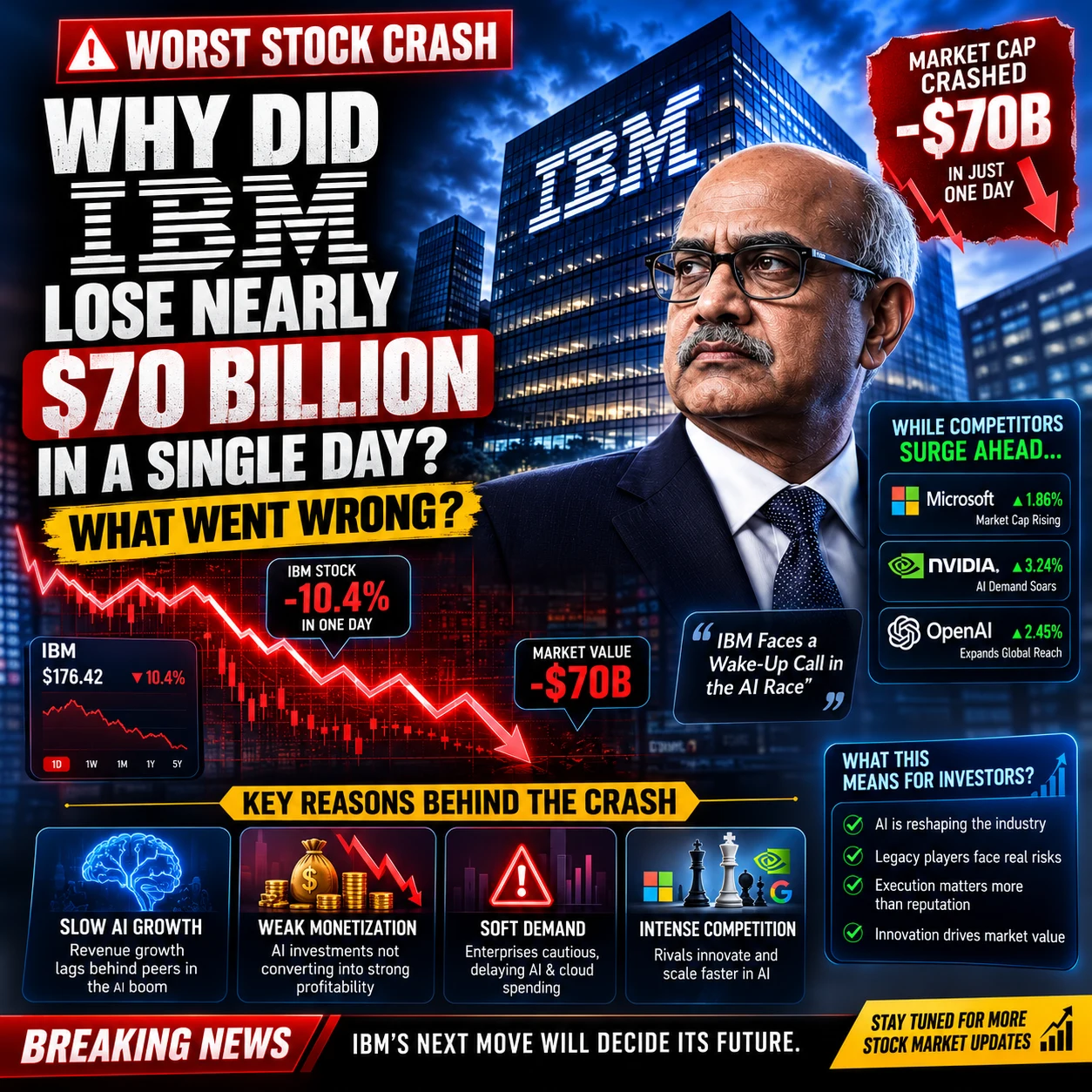
Why Did IBM Lose Nearly $70 Billion in a Day After Falling Behind in the AI Race?

IBM

IBM lost nearly $70 billion in market value in a single trading session after investors reacted sharply to disappointing earnings, slower-than-expected AI momentum, and CEO Arvind Krishna’s acknowledgment that the company had “faltered” in adapting to the rapidly evolving artificial intelligence landscape. The dramatic sell-off marked one of IBM’s worst single-day stock declines in decades, raising concerns about its ability to compete with technology giants leading the AI revolution. As artificial intelligence continues to reshape enterprise technology, investors are rewarding companies that demonstrate strong AI-driven growth while becoming increasingly critical of those perceived to be falling behind. IBM, once considered one of the pioneers in enterprise computing and AI, suddenly found itself at the center of that conversation. So, why did IBM lose nearly $70 billion in a single day? Was the sell-off purely driven by one disappointing earnings report, or does it reflect deeper concerns about the company’s long-term strategy in an AI-first world? In this article, we’ll examine the key reasons behind IBM’s historic market decline, what CEO Arvind Krishna’s comments really mean, how the AI race is changing investor expectations, and whether IBM can regain its position as a leader in enterprise technology. What Happened With IBM ? On July 14, IBM surprised investors by releasing preliminary second-quarter financial results ahead of its scheduled earnings announcement. The company reported revenue of approximately $17.2 billion, representing only modest year-over-year growth and falling short of Wall Street expectations. Adjusted earnings per share also came in below analyst forecasts. More concerning than the numbers themselves was IBM’s explanation for the slowdown. In a letter to investors, CEO Arvind Krishna acknowledged that the company had underestimated how quickly customers would redirect their technology budgets toward AI infrastructure. “These conditions require our teams to execute perfectly, and this quarter we faltered. We did not adapt and move quickly enough.” Such direct language is unusual from the CEO of a major publicly traded technology company, and it immediately raised concerns among investors who had expected IBM to be one of the biggest beneficiaries of enterprise AI adoption. Instead, the company revealed that many customers had delayed or reduced spending on software and traditional infrastructure projects while prioritizing investments in servers, storage, memory, and other AI-related hardware. IBM’s $70 Billion Sell-Off at a Glance Factor What Happened Why It Mattered Preliminary Earnings Revenue and earnings missed analyst expectations. Investors questioned IBM’s near-term growth outlook. CEO’s Statement Arvind Krishna admitted IBM had “faltered” in adapting to market changes. The comments weakened investor confidence. AI Spending Shift Customers redirected budgets toward AI infrastructure. Traditional software spending slowed significantly. Market Reaction IBM shares dropped around 25% in one trading session. Nearly $70 billion was erased from the company’s market value. Investor Sentiment Concerns grew that IBM was falling behind in the AI race. Expectations for future AI-driven growth were reduced. Why Did Investors React So Strongly? A few years ago, missing quarterly estimates would have been disappointing but manageable for a company like IBM. Today’s market operates very differently. Artificial intelligence has become the primary driver of technology valuations, and investors now expect major software companies to demonstrate not only profitable businesses but also clear leadership in AI innovation. Companies that successfully monetize AI continue attracting significant investor confidence, while those perceived as moving too slowly face much harsher scrutiny. IBM’s earnings announcement arrived at a time when the market was already rewarding companies building AI infrastructure, developing generative AI platforms, and expanding cloud-based AI services. When International Business Machines acknowledged that it had underestimated this shift, investors interpreted it as a warning that the company might be losing momentum during one of the most significant technology transitions in decades. The AI Boom Is Changing How Companies Spend Money One of the biggest takeaways from International Business Machines announcement is that artificial intelligence isn’t simply creating new products—it is changing how businesses allocate their technology budgets. Historically, enterprise customers distributed spending across software, consulting, hardware upgrades, cybersecurity, and digital transformation projects. Today, many organizations are concentrating their investments on building AI capabilities. Rather than upgrading existing enterprise software, companies are increasingly purchasing: International Business Machines itself acknowledged that clients accelerated purchases of servers, storage, and memory, reducing spending in other parts of their IT budgets. This changing investment pattern doesn’t necessarily indicate weaker overall technology spending. Instead, it highlights a major shift in priorities. Businesses are investing first in the infrastructure required to deploy AI before expanding spending on broader enterprise software. Why AI Infrastructure Is Becoming More Valuable Than Traditional Software The AI revolution isn’t powered solely by applications like ChatGPT or enterprise chatbots. Behind every AI model lies enormous computing infrastructure. Organizations deploying generative AI require: As a result, companies supplying this infrastructure have become some of the biggest beneficiaries of the AI boom. Meanwhile, software vendors whose products depend on broader enterprise IT spending may experience temporary pressure as customers reallocate budgets. IBM’s recent results illustrate this transition. The company’s long-term strategy around enterprise AI remains intact, but near-term spending patterns shifted more dramatically than management anticipated. From market-moving news to expert stock analysis, we’ve got you covered. Read more articles and stay informed with DailyTopstocks.in FAQ’s  Why did IBM lose nearly $70 billion in a single day?  IBM lost nearly $70 billion in a single day after its shares plunged following weaker-than-expected earnings and concerns that the company had fallen behind in the AI race. Investors were further unsettled after CEO Arvind Krishna acknowledged IBM had “faltered” in adapting quickly to the shift toward AI infrastructure, triggering one of the company’s biggest single-day stock declines in decades.  Can IBM still compete with Microsoft, NVIDIA, and Google in AI?  Yes, IBM can still compete in AI, but it faces intense competition from companies like Microsoft, NVIDIA, and Google. While IBM focuses on enterprise AI through its watsonx platform, hybrid cloud, and business automation solutions, it must accelerate innovation and AI adoption to keep pace with rivals that currently lead in AI infrastructure, cloud … Read more

₹2 Lakh Crore Gone in a Day: How Accenture Triggered an IT Sector Meltdown

Accenture

The Indian stock market witnessed one of the biggest shocks of 2026 when IT stocks plunged sharply, wiping out nearly ₹2 lakh crore in market value in a single trading session. The trigger? A disappointing earnings outlook from global IT services giant Accenture. What started as a weak earnings update from a U.S.-based company quickly turned into a sector-wide selloff across India’s leading IT firms, including TCS, Infosys, Wipro, HCLTech, and Tech Mahindra. But was the panic justified? And did investors really lose ₹2 trillion overnight? Let’s break down what actually happened. What Happened? On June 19, 2026, Accenture released its latest quarterly results and lowered its revenue growth forecast for FY2026. The company reduced its expected growth range to 3%-4%, down from its earlier guidance of 3%-5%. It also reported weaker-than-expected bookings and highlighted cautious client spending trends. Adding to investor concerns, Accenture revealed that geopolitical disruptions in the Middle East could impact revenue by approximately $400 million. While these numbers may seem specific to Accenture, investors viewed them as a warning sign for the entire global IT services industry. Why Did Indian IT Stocks Fall So Hard? Accenture is widely considered a barometer for global technology spending. When the company signals weaker demand, investors often assume similar challenges could affect Indian IT service providers. As a result, heavy selling was seen across major Indian IT stocks: The Nifty IT index recorded one of its steepest single-day falls of the year as investors rushed to reduce exposure to the sector. Did Investors Really Lose ₹2 Lakh Crore? Yes and no. The widely reported ₹2 lakh crore figure refers to market capitalization erosion, not actual cash losses. Market capitalization represents the combined value of listed companies based on their stock prices. When share prices fall, the market value of those companies decreases. This does not mean investors physically withdrew ₹2 lakh crore from the market. Instead, it reflects the reduction in the overall valuation of listed IT companies. Several financial reports estimated the loss between ₹1.35 lakh crore and ₹2 lakh crore, depending on which companies and indices were included in the calculation. For more detailed insights, you can read the full article on Times of India. The Bigger Concerns Behind the Selloff Accenture‘s earnings were only the trigger. Several underlying concerns were already weighing on the IT sector. 1. AI Disruption Fears Artificial Intelligence continues to transform the technology industry. Investors worry that AI-driven automation could reduce demand for traditional outsourcing services, which have long been a major revenue source for Indian IT companies. While AI creates new opportunities, many investors remain uncertain about how quickly these companies can adapt their business models. 2. Weak Global Technology Spending Many businesses worldwide are still cautious about spending on large-scale digital transformation projects. Companies are prioritizing essential investments while delaying discretionary technology spending. This directly impacts revenue growth for IT service providers. 3. Slower Outsourcing Demand Accenture‘s weaker bookings suggest that clients are taking longer to approve major outsourcing contracts. For Indian IT firms, which rely heavily on long-term service agreements, this trend is particularly concerning. 4. Geopolitical Uncertainty Global conflicts and economic uncertainty continue to affect business confidence. Companies often delay technology investments during uncertain periods, creating additional pressure on the IT services industry. What Are Analysts Saying? Several major brokerage firms expressed caution following Accenture‘s results. Key concerns include: Many analysts believe investors should closely monitor upcoming quarterly results before making major investment decisions. Is This a Buying Opportunity? That depends on your investment horizon. Short-term investors may continue to face volatility as markets digest concerns around AI, global spending, and earnings growth. However, long-term investors are watching for: Historically, leading Indian IT companies have successfully navigated multiple industry disruptions, but investors should remain selective and focus on business fundamentals. What Investors Should Watch Next The next few months could determine the direction of the IT sector. Key developments to monitor include: These indicators will provide a clearer picture of whether the recent selloff was an overreaction or a sign of deeper challenges ahead. Final Thoughts The headline claiming that investors lost ₹2 lakh crore is broadly accurate from a market capitalization perspective, but it doesn’t represent actual money leaving investors’ bank accounts. The selloff was triggered by Accenture‘s weaker outlook, but broader concerns around AI disruption, slowing outsourcing demand, cautious technology spending, and geopolitical uncertainty played equally important roles. For now, investors should focus less on sensational headlines and more on upcoming earnings, deal pipelines, and long-term industry trends. Want to stay ahead of the market? Don’t miss our Daily Top Stock Picks blog, where we cover trending stocks, major market moves, expert insights, and opportunities investors should watch every day. FAQ’s 1. Why did Indian IT stocks crash after Accenture’s earnings report? Indian IT stocks fell sharply after Accenture lowered its FY2026 revenue growth forecast and reported weaker-than-expected bookings. Investors viewed this as a sign of slowing global demand for IT services, triggering a sector-wide selloff. 2. Did investors really lose ₹2 lakh crore in one day?The ₹2 lakh crore figure refers to market capitalization erosion, not actual cash losses. It represents the decline in the combined market value of listed IT companies due to falling stock prices. 3. Which Indian IT stocks were most affected by the selloff?Major IT companies including TCS, Infosys, Wipro, HCLTech, and Tech Mahindra witnessed significant declines as investors reacted to concerns about global technology spending and outsourcing demand. 4. Is the recent IT sector crash linked to Artificial Intelligence (AI)?Partly. Investors are concerned that AI-driven automation could reduce demand for traditional outsourcing services. However, AI is also creating new opportunities for IT companies that successfully adapt to changing client needs. 5. What concerns did Accenture highlight in its earnings report?Accenture pointed to weaker bookings, cautious client spending, slower outsourcing demand, and geopolitical disruptions that could affect future revenue growth. 6. Is this a good time to invest in IT stocks?Investment decisions depend on individual goals and risk tolerance. Long-term investors … Read more

Global Markets Jump After US-Iran Move Toward Ending Conflict: Why Investors Are Betting on a New Era of Stability

Global Markets

Global markets rallied strongly after reports emerged that the United States and Iran are moving toward ending months of conflict in the Gulf region. Investors responded positively to news of a proposed 14-point Islamabad Memorandum, which could pave the way for greater geopolitical stability and smoother global trade flows. Key Highlights of the Islamabad Memorandum The proposed framework is not a final peace agreement but serves as a roadmap toward de-escalation. The main points include: Even though the agreement remains in its early stages, markets reacted positively to the possibility of reduced tensions. Why the Strait of Hormuz Matters The Strait of Hormuz remains one of the world’s most critical energy corridors. Key Facts: As confidence grew that shipping would resume normally, traders quickly reduced the geopolitical risk premium built into oil prices. Markets React Positively Global equity markets posted significant gains: United States Markets US futures also reflected strong investor optimism: Oil Prices Fall Sharply Energy markets reacted in the opposite direction as geopolitical concerns eased. Crude Oil Performance Important Context Despite the decline: Sectors Benefiting from Lower Oil Prices Lower crude oil prices typically benefit industries that rely heavily on fuel and transportation costs. The biggest beneficiaries include: At the same time, energy producers may face pressure as lower oil prices can impact their profitability. This shift often leads investors to rotate funds from energy stocks into sectors that benefit from cheaper operating costs. What This Means for India India stands to gain significantly from any sustained decline in oil prices. As a country that imports more than 80% of its crude oil requirements, lower energy costs can have a meaningful impact on economic growth, inflation, and market sentiment. Equity Market Performance Currency Market Several sectors led the rally, including: Stocks such as Tata Motors, Maruti Suzuki, Larsen & Toubro, and Bajaj Finance emerged among the top gainers as investors positioned themselves for a potentially more favorable economic environment. Long-Term Benefits for India If the agreement progresses successfully and oil prices remain stable, India could experience several long-term advantages: Historically, Indian equity markets have performed well during periods of stable or declining crude oil prices, as lower energy costs improve margins and support economic growth. Why Investors Should Remain Cautious Despite the optimism, several uncertainties remain. The memorandum is only the first step toward a broader agreement, and previous diplomatic efforts have often faced delays or setbacks. Additionally, the physical normalization of shipping routes and energy supplies could take several months even if a formal agreement is reached. Market participants should also remember that geopolitical situations can change rapidly, and any disruption to negotiations could quickly reverse current sentiment. Conclusion The proposed US-Iran framework has injected fresh optimism into global financial markets, with investors betting that diplomacy will reduce geopolitical risks and stabilize energy supplies. The potential reopening of the Strait of Hormuz has already pushed oil prices lower and boosted equities worldwide. For India, the development could prove especially beneficial through lower inflation, reduced import costs, stronger currency performance, and renewed foreign investment. While risks remain and the agreement is far from complete, markets are clearly signaling their preference for stability over conflict, making this one of the most closely watched geopolitical developments of the year. FAQ’s Has the US-Iran war actually ended, or is this just talk? The conflict has moved beyond diplomatic discussions, with both countries reportedly signing a memorandum of understanding on June 17. The agreement includes a ceasefire, reopening of the Strait of Hormuz, and a commitment to negotiate a broader settlement covering Iran’s nuclear program and US sanctions within 60 days. While this is a significant step forward, a final peace agreement has not yet been reached   Will oil prices keep falling from here?Not necessarily. While oil prices have fallen following the agreement, analysts remain divided on the outlook. Supply chain disruptions, lower global inventories, and the time required to restore normal exports could keep oil prices elevated in the near term.   Will this bring inflation down everywhere, including India? Lower oil prices could help reduce inflationary pressure, but the impact may not be immediate. In India, cheaper crude oil would support the rupee, reduce import costs, and ease inflation over time, though broader economic factors will also influence price trends.  Which sectors and stocks stand to gain the most?  Sectors that benefit from lower fuel and transportation costs are expected to be the biggest winners. These include aviation, automobiles, logistics, banking, financial services, real estate, and metals. In India, stocks from these sectors have already responded positively to the easing geopolitical tensions. Kishan Rajawatdailytopstocks.in/

How AI Is Changing Stock Trading in 2025: Tools, Trends & Risks

How AI Is Changing Stock Trading in 2025: Tools, Trends & Risks

Artificial Intelligence (AI) is transforming the stock market faster than ever before. In 2025, retail and professional traders will rely heavily on AI-powered tools to make faster, smarter, and more data-driven trading decisions. From automated strategies to predictive analysis, AI is no longer optional—it has become the backbone of modern trading. What’s Driving the AI Boom in Stock Trading? AI adoption is growing because traders today want speed, accuracy, and automation. With real-time data availability and advanced machine learning models, AI makes complex trading decisions simpler and more efficient. AI Tools Transforming the Market in 2025 1. AI-Powered Trading Bots Machine-learning bots analyze charts, execute trades instantly, and remove emotional bias, making them ideal for swing and intraday trading. 2. Predictive Analytics Platforms These platforms process thousands of data points—price patterns, news, global market signals—to predict movements with high accuracy. 3. Sentiment Analysis Engines AI scans news, social media posts, and public sentiment to understand market psychology, especially useful during volatile news cycles. 4. Automated Risk Management AI helps traders: 5. AI-Enhanced Portfolio Optimization AI builds optimized portfolios based on risk profile, historical data, and market conditions to maximize returns. Top AI Trends in Stock Trading (2025) 1. Hyper-Personalized Strategies AI now designs unique trading strategies tailored to each user’s behaviour, risk profile, and favourite indicators. 2. Human + AI Hybrid Trading Most traders use AI for insights while manually executing final trades—creating a perfect balance. 3. Voice-Activated Trading Assistants Voice-driven tools allow traders to get market insights or execute commands instantly. 4. AI for Options and Derivatives Advanced AI models predict volatility, analyze Greeks, and identify profitable options strategies. Benefits of AI in Stock Trading The Risks You Should Know 1. Over-Reliance on AI Depending completely on automated tools can make traders unaware of key fundamentals. 2. Wrong Predictions No AI can accurately predict black-swan events or sudden market disruptions. 3. Data Bias If the AI model is trained with poor or incomplete data, the output may be inaccurate. 4. Technical Failures System glitches or bot errors can sometimes result in significant losses. Should Retail Traders Use AI in 2025? Yes—AI is extremely helpful, but it must be used as a tool, not a replacement for human judgment. The best-performing traders in 2025 combine their own research with AI-powered insights. Conclusion AI is reshaping stock trading by making it faster, smarter, and more efficient. However, traders must also understand the risks and use AI responsibly. The future belongs to traders who use the right balance of technology and human expertise. FAQs 1. Is AI accurate for stock trading in 2025? AI tools are highly accurate for pattern detection and trend prediction, but they are not 100% reliable during unexpected market events. 2. Can beginners use AI for trading? Yes! Many platforms offer beginner-friendly AI tools that simplify chart reading, market analysis, and decision-making. 3. Does AI eliminate risk in stock trading? No. AI reduces risk but cannot remove it completely. Sudden news events or global changes can still impact markets unpredictably. 4. Are AI trading bots legal in India? Yes, using AI tools and bots is legal as long as they comply with the trading platform’s rules and the guidelines set by SEBI. 5. Which is better—manual trading or AI trading? A combination of both works best. AI provides data-driven insights, while human judgment manages emotional and strategic decisions. Muskan BansalMuskan Bansal is a finance enthusiast with a keen interest in financial news and sports. With a passion for staying up-to-date with the latest developments in the world of finance, Muskan combines a strong analytical mindset with a love for sports to gain a well-rounded perspective. Equipped with a deep understanding of both domains, Muskan seeks to bridge the gap between finance and sports, exploring the intersection of these two diverse fields.

Is the Bull Run Back? Analyzing the Market Momentum in March 2025

Bull Run

Introduction As in March ending, one question seems to echo across Dalal Street and investment circles alike—Is the bull run truly back? After months of market volatility, cautious optimism is beginning to replace fear. Retail investors, institutional players, and market analysts are closely watching trends, hoping that the momentum seen in recent weeks signals the beginning of a new bullish phase in the Indian stock market. But is this Recovery real or just a temporary bounce? Let’s dig into what’s really going on. Why Is the Bull Run Back? The term ‘bull run’ refers to a sustained period where stock prices keep rising, driven by strong investor confidence and robust economic signals. March 2025 seems to be ticking many of those boxes. Several key developments are fueling this new optimism: In short, both domestic fundamentals and global signals are aligning to support a bullish trend. How the Bull Run Affected the Indian Stock Market The impact of this rally is already visible. Benchmark indices such as the Nifty 50 and BSE Sensex have surged, touching new 52-week highs. Some of the standout developments include: It’s not just the stock market, even mutual funds are witnessing higher SIP inflows, showing that investor participation is broad-based. Factors Affecting the Bull Run While the momentum is exciting, it’s essential to understand what’s driving it—and what could derail it. Some of the major factors influencing this bull run in India are: However, one must be cautious. Factors like unexpected inflationary spikes, global conflict, or commodity price shocks can still shake this momentum. Analyzing the Market Momentum in March 2025 March 2025 has brought a breath of fresh air for investors, and the numbers tell an interesting story. After months of sideways movement and uncertain sentiment, the Indian stock market seems to have found its rhythm again. But this time, it’s not just a speculative rally—it’s driven by real economic signals, policy direction, and investor conviction. 1. Index Movements Reflect Confidence Both the Nifty 50 and BSE Sensex have displayed strong upward momentum in March. The Sensex recently crossed the 74,000 mark, while the Nifty breached the psychological level of 22,500. These gains aren’t just happening in isolation. They’re backed by higher trading volumes, improved earnings data, and bullish technical indicators like 50-day and 200-day moving averages crossing over. Interestingly, the rally is not limited to large-cap stocks. Mid-cap and small-cap indices have outperformed, showing a broad-based recovery. This suggests that investors are moving beyond the safety of blue-chip stocks and are willing to take calculated risks—a classic sign of a strengthening bull market. 2. Sectoral Trends: Where the Money Is Flowing Some sectors have clearly emerged as the frontrunners in this bull run: 3. FII and DII Activity Another major driver of momentum this month has been the renewed interest from Foreign Institutional Investors (FIIs). After pulling out funds in late 2024 due to global uncertainties, FIIs are returning to India, viewing it as a stable, high-growth emerging market. On the other hand, Domestic Institutional Investors (DIIs), including mutual funds and insurance companies, have remained consistent in their support, especially through SIPs (Systematic Investment Plans). This dual support has helped sustain upward momentum without too much volatility. 4. Retail Investor Sentiment Retail investors are more active than ever. Platforms like Zerodha, Groww, and Upstox are reporting increased new account openings, especially from Tier 2 and Tier 3 cities. The younger demographic—those in their 20s and 30s—are showing higher participation rates, driven by financial literacy, better access to information, and trust in long-term wealth creation through equities. 5. Technical Analysis Insights From a technical standpoint, several indicators are flashing bullish signs: In summary, March 2025 has been a defining month so far. With solid sectoral support, FII inflows, strong retail participation, and positive macroeconomic cues, the momentum feels more sustainable than speculative. However, smart investors will keep an eye on global trends, inflation data, and geopolitical events that could throw curveballs in the coming months. Conclusion So, is the bull run back? All signs point to a cautiously optimistic yes. While we can’t predict the future, the current indicators show that India is well-positioned for sustained market growth—driven by strong fundamentals, policy support, and improving investor sentiment. For Indian investors, this could be a golden phase to stay invested, review portfolios, and think long-term. As always, diversification and informed decision-making will remain your best tools in navigating this dynamic market. FAQs Q1. Will the bull market continue in 2025? While no one can predict with certainty, current trends and economic indicators will play a key role in determining if the bull market continues in 2025. Staying updated and diversified is essential. Q2. What are the signs of the end of a bull market? Signs of a bull market ending include slowing economic growth, rising interest rates, high stock valuations, and increased market volatility. Keep an eye on investor sentiment and earnings reports. Q3. What is the stock market prediction for 2025? Stock market predictions for 2025 vary, but many analysts expect moderate growth driven by tech, AI, and clean energy sectors. However, global events and interest rate changes could impact outcomes. Q4. How long will the bull market last? There’s no set timeline for a bull market. It can last months or years, depending on economic growth, corporate earnings, interest rates, and investor confidence. Naman Udhani

BSE vs NSE: Which Is Better for Stock Market Beginners in 2024?

BSE vs NSE for beginners in 2024

Introduction BSE vs NSE In the bustling world of stock trading, where every decision counts, choosing the right platform is crucial, especially for beginners stepping into the dynamic realm of the stock market. The BSE vs NSE stand as two pillars of India’s financial landscape, each with its own merits and demerits. Choosing between the Bombay Stock Exchange (BSE) and the National Stock Exchange (NSE) for beginners in 2024 depends on several factors, including ease of use, accessibility, trading fees, liquidity, and the availability of educational resources. But which one is better suited for beginners in the year 2024? Let’s explore both the option to uncover the answer. Here’s a comparison to help you decide: Understanding BSE vs NSE Bombay Stock Exchange (BSE): Established in 1875, BSE is Asia’s oldest stock exchange and ranks among the world’s top exchanges in terms of market capitalization. BSE facilitates trading in equities, derivatives, mutual funds, and debt instruments. It is renowned for its benchmark index, the Sensex, which comprises 30 of the largest and most actively traded stocks on the exchange. Image Source: bl-i.thgim.com National Stock Exchange (NSE): Founded in 1992, NSE is a relatively newer entrant but has quickly risen to prominence, becoming the largest stock exchange in India by both trading volume and market capitalization. NSE offers a wide range of financial products, including equities, derivatives, exchange-traded funds (ETFs), and debt securities. Its flagship index, the Nifty 50, tracks the performance of 50 large-cap stocks listed on the exchange. Image Source: livemint.com Accessibility and Liquidity: Both BSE vs NSE are major stock exchanges in India, offering a wide range of listed companies and financial instruments. However, NSE is typically considered more liquid and has higher trading volumes compared to BSE. Higher liquidity can result in narrower bid-ask spreads and better price discovery, making it potentially more suitable for beginners. Trading Fees: The trading fees charged by brokers may vary between BSE vs NSE. Beginners should compare brokerage charges, transaction fees, and other costs associated with trading on each exchange to determine which one offers the most cost-effective solution. Ease of Use and Technology: NSE is known for its advanced trading technology and user-friendly trading platforms, which can be beneficial for beginners who are just starting to navigate the stock market. BSE also offers online trading platforms and mobile apps, but it’s essential to assess the usability and features offered by each exchange’s trading platforms. Educational Resources: Both BSE vs NSE provide educational resources and investor awareness programs to help beginners understand the basics of investing and trading in the stock market. Beginners may want to explore the educational materials, seminars, webinars, and online courses offered by each exchange to enhance their knowledge and skills. Regulatory Oversight: Both BSE vs NSE are regulated by the Securities and Exchange Board of India (SEBI), which ensures fair and transparent trading practices in the Indian capital markets. Beginners can have confidence in the regulatory oversight provided by SEBI, regardless of the exchange they choose to trade on. Conclusion Ultimately, the choice between BSE vs NSE for beginners in 2024 depends on individual preferences, trading objectives, and comfort levels. It’s advisable for beginners to research and compare the features, services, and costs offered by both exchanges before making a decision. Additionally, seeking guidance from experienced investors or financial advisors can help beginners navigate the complexities of the stock market more effectively. In conclusion, BSE vs NSE offer viable options for beginners venturing into the stock market in 2024. While NSE may appeal to those seeking advanced trading features and higher liquidity, BSE’s legacy and stability can instill confidence in risk-averse investors. Beginners are encouraged to conduct thorough research, seek guidance from financial experts, and start with small investments to gain hands-on experience and navigate the complexities of the stock market effectively. With diligence and perseverance, beginners can embark on a rewarding journey towards financial success, regardless of whether they choose BSE, NSE, or both. Also read our previous news: शेयर बाजार शनिवार, 2 मार्च को भी खुलेगा। सर्किट लिमिट और इंट्राडे-डे में ये बदलाव समस्या पैदा कर सकते हैं। Muskan BansalMuskan Bansal is a finance enthusiast with a keen interest in financial news and sports. With a passion for staying up-to-date with the latest developments in the world of finance, Muskan combines a strong analytical mindset with a love for sports to gain a well-rounded perspective. Equipped with a deep understanding of both domains, Muskan seeks to bridge the gap between finance and sports, exploring the intersection of these two diverse fields.

शेयर बाजार शनिवार, 2 मार्च को भी खुलेगा। सर्किट लिमिट और इंट्राडे-डे में ये बदलाव समस्या पैदा कर सकते हैं।

शेयर बाजार

शेयर बाज़ार शनिवार, 2 मार्च को भी खुलेगा, जो एक अत्यंत महत्वपूर्ण और व्यापक रूप से चर्चित घटना है। इस नए सत्र से शेयर बाजार में कुछ अहम बदलाव होंगे जो निवेशकों के लिए काफी अहम हो सकते हैं। आइए देखें कि ये परिवर्तन स्वयं कैसे प्रकट होंगे: शनिवार को शेयर बाजार फिर से खुलने पर इन बदलावों के लिए निवेशकों को सावधानी और तैयारी की आवश्यकता होती है। ये बदलाव बाज़ार के लिए चुनौतियाँ पैदा कर सकते हैं, लेकिन समय-समय पर सही जानकारी और निवेश सुरक्षा के ज़रिए निवेशक इन चुनौतियों से पार पा सकते हैं। दोनों सत्रों की समय सीमा क्या है? पहला सत्र मुख्य स्थान पर आयोजित किया जाएगा और सुबह 9:15 बजे से खुला रहेगा। प्रातः 10:00 बजे तकदूसरा सत्र सुबह 11:30 बजे शुरू होगा। और दोपहर 12:30 बजे समाप्त होता है। Image Source: jagranimages.com प्री-लॉन्च बैठकों की तारीखें इस प्रकार हैं: पहला सत्र सुबह 9:00 बजे से प्रातः 9:08 बजे तकदूसरा सत्र सुबह 11:15 बजे से। प्रातः 11:23 बजे तकसत्र का समापन 12:40 से 12:50 तक कृपया ध्यान दें कि छुट्टी के कारण, कुछ दलाल इस विशेष पेशकश से लाभ प्रदर्शित करने में असमर्थ हैं। इसके बावजूद, कुछ प्रतिभूति कंपनियाँ इंट्रा-डे ट्रेडिंग को निलंबित कर सकती हैं। इसके अलावा, सभी शेयरों के लिए सर्किट लिमिट 5% है। जनवरी में होना था यह स्पेशल सत्र: 2 मार्च को जो स्पेशल ट्रेडिंग होनी है, वह जनवरी में ही होनी थी। इसके लिए 20 जनवरी का दिन फिक्स किया गया था। हालांकि इस दिन नॉर्मल ट्रेडिंग हुई, जैसे कि सोमवार से शुक्रवार के आम दिनों में होता है। 22 जनवरी को, सोमवार, अयोध्या के राम मंदिर के प्राण प्रतिष्ठा समारोह के मौके पर स्टॉक्स एक्सचेंज बंद थे। स्पेशल ट्रेडिंग सत्र इसलिए हो रहा है, ताकि साइबर हमले या सर्वर क्रैश की विषम परिस्थितियों में भी ट्रेडिंग जारी रह सके। इससे न केवल ट्रेडिंग जारी रहेगी, बल्कि डेटा भी सुरक्षित रहेगा। इस विशेष सत्र के दौरान ट्रेडिंग करते समय यह ध्यान रखें कि उच्च और निम्न सर्किट लिमिट 5 फीसदी होगी और कुछ ब्रोकरेज फर्म में इंट्रा-डे ट्रेडिंग बंद रह सकती है। ट्रेडिंग से पहले सम्पूर्ण जानकारी हासिल करें और निवेश की समय-समय पर जांच करें। निष्कर्ष (शेयर बाजार) शेयर बाजार का शनिवार को खुलना निश्चित रूप से कुछ चुनौतियों का सामना ला सकता है। Image Source: zeebiz.com सर्किट लिमिट में बदलाव: सर्किट लिमिट में बदलाव से बाजार में अस्थिरता बढ़ सकती है। निवेशकों को अचानक उतार-चढ़ाव के लिए तैयार रहना होगा। जोखिम प्रबंधन और सावधानीपूर्ण निवेश रणनीति महत्वपूर्ण होगी। इंट्राडे-डे में बदलाव: इंट्राडे-डे में बदलाव से ट्रेडिंग रणनीति में बदलाव की आवश्यकता हो सकती है। ट्रेडरों को नए नियमों के अनुकूल होने और अपनी रणनीतियों को समायोजित करने की आवश्यकता होगी। तकनीकी विश्लेषण और बाजार की गतिविधियों पर ध्यान देना महत्वपूर्ण होगा। सामान्य रूप से, शेयर बाजार का शनिवार को खुलना निश्चित रूप से कुछ चुनौतियों का सामना ला सकता है। निवेशकों और ट्रेडरों को इन चुनौतियों के लिए तैयार रहना होगा और अपनी रणनीतियों को तदनुसार समायोजित करना होगा। इसके अलावा, यह ध्यान रखना महत्वपूर्ण है कि शेयर बाजार में हमेशा जोखिम शामिल होता है। निवेशकों को केवल उतना ही पैसा निवेश करना चाहिए जितना वे खोने का जोखिम उठा सकते हैं। यहां कुछ महत्वपूर्ण बातें हैं जिन पर आपको ध्यान देना चाहिए: इन बातों पर ध्यान देने से आपको शेयर बाजार में सफलता प्राप्त करने में मदद मिलेगी। Also, Read: 12 फीसदी तक शेयर में गिरावट, 45 हजार करोड़ रुपये इकट्ठा करने की योजना भी काफी नहीं: Vodafone Idea Yash Jain

12 फीसदी तक शेयर में गिरावट, 45 हजार करोड़ रुपये इकट्ठा करने की योजना भी काफी नहीं: Vodafone Idea

शेयर

कंपनी ने घोषणा की है कि वह इक्विटी या इक्विटी-संबंधित उपकरणों के माध्यम से 20,000 करोड़ रुपये जुटाएगी और शेष धनराशि ऋण और निवेशकों के माध्यम से निवेश करने का प्रस्ताव रखती है। एक दूरसंचार कंपनी जो व्यक्तियों को फ़ोन कॉल करने में मदद करती है, वित्तीय कठिनाइयों का सामना कर रही है और उसे अतिरिक्त धन की आवश्यकता है। कंपनी के अधिकारियों ने 45,000 करोड़ रुपये की मदद लेने का फैसला किया है. लेकिन इतनी बड़ी रकम के बावजूद कंपनी के शेयर एक दिन में 12 फीसदी तक गिर गए. सुबह की शुरुआत में शेयर की कीमत 14 रुपये थी. कंपनी की योजना कंपनी का कुछ हिस्सा निवेशकों को बेचकर और बाकी रकम उधार लेकर 20,000 करोड़ रुपये जुटाने की है। कंपनी के मालिक भी कुछ पूंजी का योगदान देंगे। 2 अप्रैल को एक बैठक निर्धारित है जिसमें शेयरधारक इस बात पर मतदान करेंगे कि वित्तपोषण योजना को लागू किया जाए या नहीं। आने वाले महीनों में फंड आने की उम्मीद है। Image Source: deccanherald.com शेयर की गिरती कीमतें वोडाफोन आइडिया के शेयर 28 फरवरी को एनएसई पर 4.45 फीसदी की गिरावट के साथ 16.1 रुपये पर बंद हुए। हालांकि, 22 फरवरी को बोर्ड द्वारा वित्तपोषण योजना की घोषणा के बाद से कंपनी के शेयरों में 5.2% की बढ़ोतरी हुई है। स्टॉक एक्सचेंज को दिए गए कंपनी के बयान के अनुसार, प्रस्तावित वित्तपोषण का उद्देश्य इसके ऑपरेटिंग मेट्रिक्स में उल्लेखनीय सुधार करना है। पिछली 10 तिमाहियों में, कंपनी ने अपने 4जी ग्राहक आधार और प्रति उपयोगकर्ता औसत राजस्व (एआरपीयू) में लगातार वृद्धि दर्ज की है। कंपनी का वित्तीय स्वास्थ्य वित्तीय वर्ष 2023-24 की तीसरी तिमाही में, दूरसंचार ऑपरेटर ने 6,985.9 करोड़ रुपये का शुद्ध घाटा दर्ज किया, जो पिछले वर्ष की समान अवधि के 7,990 करोड़ रुपये की तुलना में 12.56 प्रतिशत कम है। हालांकि, राजस्व सालाना आधार पर 0.49 प्रतिशत बढ़कर 10,673.1 करोड़ रुपये हो गया। वोडाफोन आइडिया, आदित्य बिरला समूह और वोडाफोन समूह का एक संयुक्त उद्यम, 2जी, 3जी और 4जी प्लेटफॉर्म पर राष्ट्रव्यापी वॉयस और डेटा सेवाएं प्रदान करता है।इस वृद्धि और कंपनी की वित्तीय स्थिति के बावजूद, शेयर बाजार में गिरावट आई, जिससे अधिकांश प्रशंसकों में चिंता पैदा हो गई। हालाँकि, बोर्ड द्वारा पहल करने और तत्काल कार्रवाई की योजना बनाने से, कंपनी आगे बढ़ने के लिए अच्छी स्थिति में है। Image Source: indiatv.in वोडाफोन आइडिया के शेयर मूल्य में गिरावट का मुख्य कारण वित्तीय दुविधा और बाजार की समग्र प्रतिक्रिया है। हालाँकि, यदि कंपनी की प्रस्तावित योजना का समर्थन किया जाता है, तो स्टॉक में उतार-चढ़ाव हो सकता है। इस दौरान वित्तीय निवेशकों को स्थिरता प्रदान करने की आवश्यकता है ताकि वे अपने निवेश निर्णयों को समझ सकें और सूचित रह सकें।वोडाफोन आइडिया के शेयर मूल्य में गिरावट के बावजूद, वित्तीय निर्णय निर्माता भविष्य को लेकर आशावादी हैं और योजना बना रहे हैं। भविष्य में कंपनी की वित्तीय स्थिति और शेयर बाजार की स्थिति पर नजर रखना जारी रखें। निष्कर्ष: वोडाफोन आइडिया की ₹45,000 करोड़ जुटाने की योजना भी नाकाफी नजर आ रही है। कंपनी के शेयरों में 12% की गिरावट आई है, जिससे पता चलता है कि निवेशक कंपनी के भविष्य को लेकर चिंतित हैं। कंपनी को अपनी वित्तीय स्थिति में सुधार के लिए गंभीर कदम उठाने की जरूरत है, जैसे कि ऋण चुकाना, लागत कम करना और राजस्व बढ़ाना। यह देखना बाकी है कि क्या कंपनी इन चुनौतियों से पार पाकर सफल वापसी कर पाती है या नहीं। Also, Read: Market Dynamics: Exploring SBI Securities’ Optimistic Projections for the Indian Stock Market Muskan BansalMuskan Bansal is a finance enthusiast with a keen interest in financial news and sports. With a passion for staying up-to-date with the latest developments in the world of finance, Muskan combines a strong analytical mindset with a love for sports to gain a well-rounded perspective. Equipped with a deep understanding of both domains, Muskan seeks to bridge the gap between finance and sports, exploring the intersection of these two diverse fields.

Market Dynamics: Exploring SBI Securities’ Optimistic Projections for the Indian Stock Market

SBI Securities

Introduction: Embark on a journey through the intricacies of the Indian stock market with insights from SBI Securities. In this detailed exploration, we’ll unravel their latest analysis, offering valuable perspectives on market trends and sectoral opportunities. Let’s delve deeper into their findings to uncover potential pathways for investors. Set out on an excursion into the perplexing universe of market elements as we investigate SBI Securities’ projections for the Indian financial exchange.SBI Securities, an obvious player in the money-related business, offers critical encounters and gauges that shape monetary supporter decisions and market strategies. In this examination, we’ll jump into the guesses, assessments, and perspectives given by SBI Securities, uncovering knowledge of the components driving the Indian monetary trade’s fluctuations and examples. Oblige us as we loosen up the complexities of market components and gain a more significant cognizance of SBI Securities’ outlook for what the future holds. Nifty 50: Mapping the Path to Growth Despite recent volatility, the Nifty 50 index remains resilient, hinting at underlying optimism. SBI Securities identifies an Ascending Triangle pattern, suggesting a bullish outlook. Should the index breach key resistance levels around 22,150 – 22,200, a significant uptrend towards 22,500 and 22,700 could ensue. Investors can take comfort in the 20-day Exponential Moving Average (EMA) acting as a support level at 21,784. With market sentiment cautiously optimistic, monitoring price action and key technical indicators will be crucial in navigating potential fluctuations and seizing opportunities for growth in the Nifty 50. Staying up to date with SBI Securities’ experiences and examination can give important direction to financial backers trying to profit from the file’s vertical energy. Image Source: hindi.news24online.com Bank Nifty: Charting a Course for Renewed Momentum The Bank Nifty, undergoing a phase of stabilization, presents intriguing possibilities for investors. Supported by the 200-day EMA, the index exhibits signs of a Symmetrical Triangle pattern, poised for a breakthrough. A sustained rise above the 50-day Moving Average (DMA) levels of 46,750 – 46,800 could propel the index towards the milestone of 48,000. In times of market turbulence, the 10-20 EMA zone serves as a buffer, offering support in the range of 46,000 – 45,800. Amid these specialized pointers, financial backer opinion remains hopeful but still sober-minded, with consideration going to key monetary information deliveries and national bank strategy choices for additional market heading. As dealers explore the advancing scene, constant observing of these help and opposition levels can assist with illuminating key exchanging choices and exploit likely open doors for benefit. Sectoral Insights: Identifying Growth Opportunities SBI Securities advocates for a selective approach, emphasizing promising sectors such as Auto, Pharma, Banking, IT, and Oil & Gas. Technical analysis suggests a potential upside in the Auto sector, with targets set at 20,800 and 21,250. Similarly, the Pharma sector displays upward momentum, eyeing the 19,600 level. Investors can monitor support levels, including the 20-day EMA and strategic zones, to navigate sectoral dynamics effectively. Besides, SBI Securities features the versatility of the Financial area amid administrative changes, with vital participants ready for development regardless of difficulties. In the IT area, advanced change drives keep on driving interest, offering worthwhile open doors for adroit financial backers. Image Source: finec.in Also, the Oil and Gas area shows a guarantee with recuperation in oil costs and key interests in sustainable power sources, introducing expected roads for long-haul development. With SBI Securities’ bits of knowledge directing their choices, financial backers can gain sectoral valuable learning experiences and enhance their speculation techniques for the most extreme returns. Conclusion: Guiding Investors through Market Volatility ( SBI Securities) As investors navigate the complexities of the stock market, SBI Securities’ insights serve as a compass, offering clarity amidst uncertainty. By leveraging technical patterns, sectoral analysis, and key support levels, investors can make informed decisions, poised for success in the ever-changing market landscape. Furthermore, SBI Securities’ examination and estimates give important direction to both prepared merchants and beginner financial backers, enabling them to explore market unpredictability with certainty. With SBI Securities close by, financial backers can weather conditions and market variances and exploit potential open doors for development and success. Also, Read our previous news: Stock market today: Nifty 50, Sensex rise over 1% this week as focus shifts to fundamentals; Wipro, M&M, SBI shine Aditya JaiswalAditya Jaiswal is a versatile writer with a keen interest in finance, games, and sports. With a passion for exploring the world of numbers and a flair for storytelling, he brings a unique perspective to his writing. Aditya’s work is informed by his analytical mind and his ability to break down complex ideas into simple concepts that anyone can understand.

Stock market today: Nifty 50, Sensex rise over 1% this week as focus shifts to fundamentals; Wipro, M&M, SBI shine

Nifty 50

Introduction (Sensex): In the dynamic world of finance, the stock market serves as a barometer of economic sentiment, reflecting the collective optimism or pessimism of investors. In the current landscape, the Nifty 50 and Sensex have experienced a notable rise of over 1% this week, signaling a shift in focus towards underlying fundamentals. Against this background, prominent organizations like Wipro, M&M, and SBI have arisen as sparkling stars, driving forward movement on the lookout. We ought to dive further into the factors adding to this upward design and research the consequences for monetary patrons and the greater economy. Securities exchange today: The homegrown market finished with gains for the week finished Friday, February 16, as financial backers shifted their concentration to basics and macroeconomic pointers while trusts persevere that the US Took care of will begin cutting rates from June this year. The expectation of rate cuts has been a critical driver for the market throughout the previous few months. While US expansion stays over the Federal Reserve’s 2% objective, the economy is giving indications of some cooling, as per the most recent information. As the Cash Street Journal uncovered, US retail bargains fell 0.8 percent in January from December — significantly more horrible than presumptions for a 0.3 percent decline. Similarly, National bank data showed January’s current creation edging down 0.1 percent differentiated and suspicions for a 0.2 percent increase. New US full-scale data has fuelled the belief that the Fed could go for rate cuts soon. “Bets for a rate cut of something like 25 reason centers in May edged up to 40 percent, while the possibilities for progress for June had at around 79%, according to the CME Get-together’s FedWatch Gadget,” nitty 50 -gritty Reuters. On Friday, esteem benchmarks the Sensex and the Smart shut with fair acquires amidst positive overall signs. Image Source: business-standard.com Smart 50 shut down at 22,040.70, up 130 spots, or 0.59 percent while the Sensex shut with an increment of 376 spots, or 0.52 percent, at 72,426.64. With this, the market benchmarks extended their advantages into the fourth constant gathering. Mid and smallcap records beat the benchmarks. The BSE Midcap list rose 0.78 percent while the Smallcap record planned an increment of 0.68 percent. The general market capitalization of the associations recorded on the BSE rose to nearly ₹389.5 lakh crore from nearly ₹387.3 lakh crore in the past gathering, making monetary supporters more luxurious by about ₹2.2 lakh crore in a single gathering. Nifty 50, Sensex this week The nifty 50 and the Sensex shut over a percent higher this week while the BSE Midcap record shut very nearly a percent higher. The BSE Smallcap record failed to meet expectations and shut level during the current week. Stocks like Wipro, Mahindra and Mahindra (M&M), SBI, Bajaj Auto, and Apollo Clinics Undertakings, shut among the top gainers in the Nifty 50 record this week. Then again, portions of Hindalco Ventures, ITC, Bharti Airtel, Hindustan Unilever, and Goodbye Steel declined on the week-by-week scale. “The Indian market proceeded with its wide-based recuperation, supported by certain worldwide signals. Further, limiting India’s import/export imbalance, driven by relaxing item costs and an assembling move by the public authority, pulled in financial backers to capital merchandise, metals, and modern stocks. On the worldwide front, an assumption for a pickup in utilization interest in China after the New Year occasions upheld the worldwide market feeling,” said Vinod Nair, Head of Exploration at Geojit Monetary Administrations. Ajit Mishra, SVP – Specific Investigation at Religare Broking suggests keeping a positive yet careful situation as Shrewd 50 is set to retest its record high. “We truly need viability of more than 22,150 to end the association and stroll towards the 22,500+ zone else benefit-taking could proceed. Dealers should keep a close watch on the monetary rundown for signals while others could continue to expect a consistent part on a rotational reason. Moreover, the introduction of the overall records, especially the US, will remain on their radar,” said Mishra. Conclusion: As the week draws to a close, the protection trade’s ascent of over 1% mirrors a reestablished highlight on critical drivers of money-related improvement and corporate execution. Associations like Wipro, M&M, and SBI stand apart for their important shows, featuring the meaning of sound fundamentals in driving monetary patron conviction. As financial backers explore the steadily changing scene of the securities exchange, remaining sensitive to shifts in opinion and essentials will be critical to settling on informed speculation choices in the long periods to come. Also, Read: Reliance Achieves Monumental Triumph: Triumphantly Surpasses Rs 20 Lakh Crore Market Cap Yash Jain