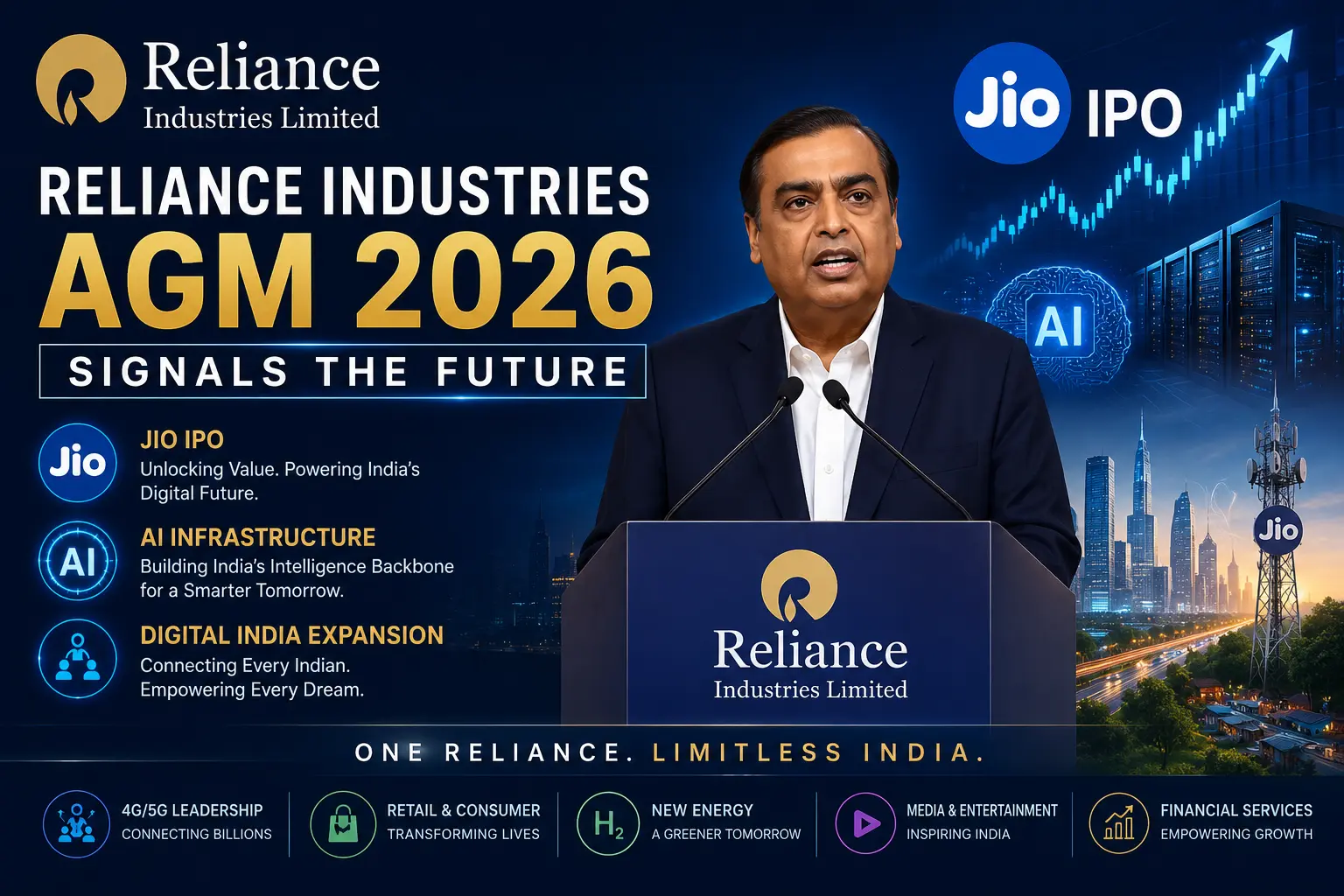
Reliance Industries AGM 2026 Signals the Future: Jio IPO, AI Infrastructure, and Digital India Expansion
Reliance Industries’ 49th Annual General Meeting on June 19, 2026 was not your typical shareholder gathering. It was a window into how Mukesh Ambani sees India’s digital economy taking shape over the next decade. The announcements covered ground that went well beyond quarterly numbers — from the long-awaited Jio IPO to sovereign AI infrastructure, satellite broadband, and serious commitments to education, healthcare, renewable energy, and domestic manufacturing.
Taken together, the roadmap Reliance laid out points in one clear direction: the company is moving well beyond its roots as an energy and telecom giant and is actively building itself into a technology-driven ecosystem that touches nearly every corner of Indian life.
Jio IPO Takes Center Stage
The announcement that dominated the room was the approval and filing of the Draft Red Herring Prospectus for Jio Platforms’ Initial Public Offering. Mukesh Ambani confirmed that Jio Platforms has officially entered the listing process — a milestone that the market has been anticipating for years.
Reports suggest the IPO could raise somewhere in the range of $3.8 to $4 billion, which would put it among the largest public offerings in Indian history. Jio Platforms currently counts over 500 million subscribers and holds a commanding share of India’s mobile data traffic — numbers that give this listing a scale few companies anywhere in the world can match.
Why this matters beyond the headline figure:
- It unlocks real value from Reliance’s digital business that has been sitting off the public market
- It brings in fresh capital specifically earmarked for future technology investments
- It provides funding to push 5G and broadband infrastructure further and faster
- It accelerates the company’s AI and cloud computing ambitions
- It puts India’s technology investment landscape on the global map in a serious way
Analysts watching the space believe this listing has the potential to become a defining moment for India’s digital economy — one that draws sustained domestic and international investor attention long after the IPO itself closes.
Reliance’s Big Bet on Artificial Intelligence
If the Jio IPO was the headline, artificial intelligence was the underlying story running through nearly everything else announced at AGM 2026.
Reliance Indutries confirmed that its AI initiative — operating under the name Reliance Intelligence — has moved from planning into active execution. The infrastructure centerpiece is being built in Jamnagar, Gujarat, and the platform is being designed to support AI services across 22 Indian languages. The practical goal behind that language coverage is significant: making AI genuinely usable for the hundreds of millions of Indians who do not operate primarily in English.
Specific AI initiatives announced on the day:
- An AI-powered assistant built into MyJio
- Jio Teleframe, a platform built for AI agents
- Jio Call Agent, a voice-based AI assistant
- AI tools for media creation and content production
- Sovereign AI infrastructure developed and owned within India
- A large-scale data center expansion program to support all of the above
The thread running through all of these is a deliberate effort to reduce India’s dependence on foreign AI platforms while making the technology genuinely affordable and accessible at scale — not just for large enterprises but for small businesses, students, and everyday users.
Satellite Broadband and the Push for Rural Connectivity
Connectivity was the third major pillar of the AGM, and the announcement here had real practical implications for parts of India that fiber networks have not yet reached.
Akash Ambani outlined a dual-track satellite strategy — partnering with established global satellite providers in the near term while simultaneously developing India’s own ground infrastructure and working toward indigenous satellite capabilities over time. The goal is straightforward: bring high-speed internet to underserved and remote regions where laying traditional cable is either too expensive or simply not feasible.
What satellite broadband actually unlocks in these regions:
- Reliable internet access for villages that have never had it
- Digital education reaching students in areas without schools or teachers
- Telemedicine services connecting rural patients with urban specialists
- Stronger communication networks during natural disasters and emergencies
- A foundation for digital commerce in communities currently excluded from it
The move puts Reliance in direct competition with global satellite internet providers for what could become one of the most contested connectivity markets of the next decade.
Building India’s AI and Data Center Infrastructure
Reliance Industries long-term strategy goes beyond telecom services.
The company is investing heavily in AI infrastructure, cloud computing, and data center capacity. Reports indicate that Jamnagar is becoming the centerpiece of Reliance’s future digital infrastructure strategy, combining AI processing, cloud services, and advanced computing capabilities.
As AI adoption accelerates across industries, data centers are expected to become critical infrastructure assets similar to highways, airports, and power grids.
Reliance appears determined to establish itself as one of the primary providers of India’s digital backbone.
Growth Plans Across the Business
While Jio and AI took up most of the oxygen in the room, Reliance also laid out growth plans across several other parts of the business that deserve attention.
Reliance Retail
Retail plans include expanding domestic manufacturing in apparel and affordable consumer electronics while continuing to strengthen Reliance’s position as the country’s largest retailer. Growth is expected from both physical store networks and digital commerce channels as the two increasingly operate as a single integrated experience.
Renewable Energy
Reliance reaffirmed its clean energy commitments with specific projects already underway or in development:
- Kutch Renewable Energy Hub
- Jamnagar Giga Complex
- Solar panel manufacturing
- Battery storage production
- Green hydrogen development
- Green ammonia partnerships
The scale of these commitments puts Reliance among the most serious corporate players in India’s energy transition — a transition that is accelerating as both policy pressure and economic logic push industry away from fossil fuels.
Education and Healthcare
Nita Ambani announced a series of social infrastructure investments that extend Reliance’s footprint well beyond commercial activity:
- A 410-acre university with a focus on AI and emerging technologies
- A major medical city development in Mumbai
- Expanded educational programs across existing institutions
- New healthcare initiatives targeting broader population access
- Urban development projects connected to these facilities
These are not small gestures. At the scale Reliance operates, investments like these have real potential to shape access to quality education and healthcare for meaningful numbers of people over the coming years.
What These Announcements Mean for India
Step back from the individual announcements and a broader picture comes into focus. Reliance is not simply expanding its business — it is positioning itself as a primary builder of the infrastructure India’s next growth cycle will run on.
The investments across AI, satellite communications, digital infrastructure, renewable energy, education, healthcare, and manufacturing line up closely with national priorities that have been articulated at the government level:
- Digital India
- Domestic AI leadership
- Energy transition away from fossil fuels
- Rural connectivity
- Technology self-reliance
- Broader economic modernization
If even a substantial portion of what was announced at AGM 2026 is delivered on schedule and at the promised scale, the impact on how ordinary Indians access technology, education, healthcare, and economic opportunity over the next ten years could be significant.
Final Thoughts
Reliance AGM 2026 may be remembered as a turning point in the company’s evolution. While the Jio IPO captured most of the attention, the bigger story was Reliance’s attempt to build a comprehensive technology ecosystem that spans AI, connectivity, cloud infrastructure, satellite communications, clean energy, and digital services.
For investors, businesses, and consumers, the announcements suggest that Reliance is positioning itself not just as India’s largest conglomerate, but as a key architect of the country’s digital future. Whether through the Jio IPO, sovereign AI infrastructure, satellite broadband, or renewable energy investments, Reliance appears focused on shaping the next chapter of India’s growth story.
And if you Want To learn more about How AI Is Changing Stock Trading in 2025: Tools, Trends & Risks then click on the link.
Frequently Asked Questions
Q1. When is the Jio IPO expected to launch and what valuation is being discussed?
Jio Platforms filed its draft IPO papers following AGM 2026 and the listing is expected to proceed after regulatory approvals come through. Market analysts are currently discussing a valuation range of $130 to $180 billion, which would make it one of the largest public offerings in Indian history by a considerable margin.
Q2. How does Reliance plan to make AI affordable for ordinary Indians?
The approach involves building large-scale AI infrastructure domestically, offering services across 22 Indian languages, expanding data center capacity, and embedding AI tools directly into Jio’s existing digital platforms. The intention is to bring down the cost of AI access for consumers, small businesses, educational institutions, and healthcare providers across the country.
Q3. Can Jio’s satellite broadband realistically compete with Starlink in India?
It has a credible path to doing so. Jio brings an existing telecom infrastructure, a subscriber base of over 500 million, deep local market knowledge, and pricing experience in one of the world’s most cost-sensitive markets. How competitive it ultimately proves to be will come down to service quality, coverage rollout speed, and how aggressively it prices against established global providers.
Q4. Why is the Jio IPO considered one of the biggest in Indian history?
Because of the sheer scale of the business behind it. Jio Platforms serves more than 500 million users, dominates India’s mobile data market, and is expected to carry a valuation north of $100 billion. No Indian technology company has gone public at anything close to this scale before.
Q5. Which sectors could benefit most from the AGM 2026 announcements?
Telecom, artificial intelligence, data center infrastructure, cloud computing, renewable energy, and digital services are the most directly connected sectors. Companies operating in technology, connectivity, clean energy, and digital infrastructure stand to benefit as Reliance accelerates spending across all of these areas over the coming years.