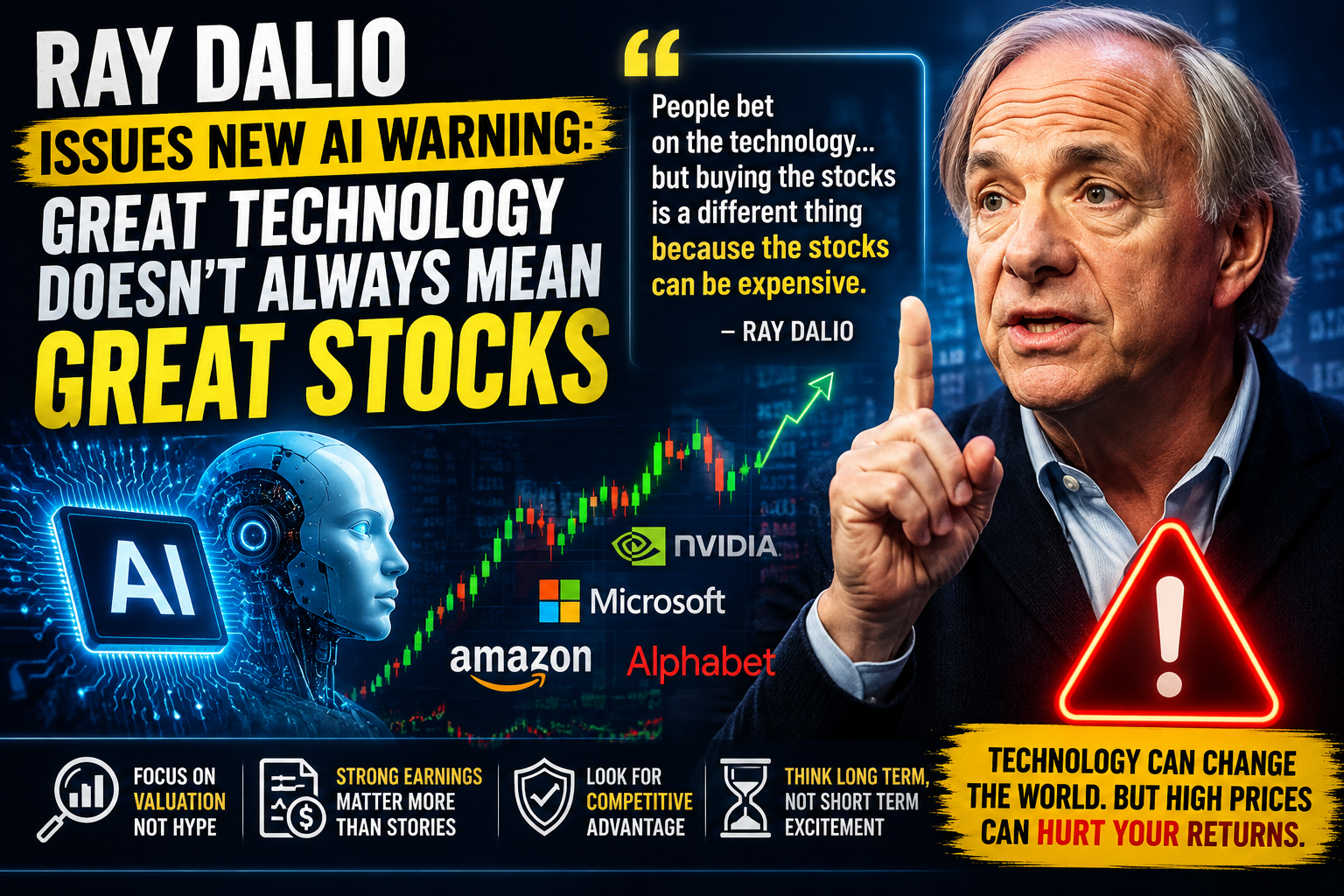
Ray Dalio Issues New Artificial Intelligence Warning: Great Technology Doesn’t Always Mean Great Stocks
Artificial Intelligence has become the biggest investment trend of the decade. From chipmakers and cloud providers to software companies, investors worldwide are pouring billions into AI-related stocks, hoping to capitalize on what many believe is the next industrial revolution.
But billionaire investor Ray Dalio has issued a timely warning that every investor should pay attention to.
His message is simple yet powerful:
“People bet on technology… but buying the stocks is a different thing because the stocks can be expensive.”
While Dalio remains optimistic about Artificial intelligence‘s ability to transform industries and reshape the global economy, he cautions that revolutionary technology does not automatically translate into profitable investments.
Who Is Ray Dalio and Why Do His Views Matter?
Ray Dalio is one of the world’s most respected investors and the founder of Bridgewater Associates, the world’s largest hedge fund, which has managed well over $100 billion in assets.
Over the past five decades, Dalio has built a reputation for identifying major economic cycles, predicting financial crises, and developing investment strategies that are followed by institutional investors, governments, and financial professionals around the world.
His books, including Principles and Principles for Dealing with the Changing World Order, have become essential reading for investors seeking to understand markets, economies, and long-term wealth creation.
Because of his track record, even a single comment from Dalio often becomes a major talking point across global financial markets.

AI Is Revolutionary—But That Doesn’t Guarantee Stock Market Success
Dalio is not questioning AI’s potential.
In fact, he believes Artificial Intelligence will fundamentally change the way businesses operate, improve productivity, and create entirely new industries.
His concern is with investor behavior.
According to Dalio, many investors assume that because Artificial intelligence is the future, every AI-related stock must also be a great investment. History, however, tells a different story.
Markets frequently become overly optimistic during periods of technological innovation, pushing stock prices far beyond what company fundamentals can justify.
Lessons From the Dot-Com Bubble
To explain his concern, Dalio points to one of history’s biggest investing lessons—the dot-com boom of the late 1990s.
The internet transformed the world exactly as many people predicted.
However, countless internet companies failed, and many investors who bought technology stocks at inflated prices suffered significant losses when the bubble burst.
Eventually, companies like Amazon emerged as dominant winners, but thousands of others disappeared.
Dalio believes Artificial Intelligence could follow a similar pattern.
The technology itself may succeed beyond expectations, but that doesn’t mean every company associated with Artificial intelligence will generate attractive long-term returns for shareholders.
Why Valuation Matters More Than Excitement
One of Dalio’s biggest concerns is valuation.
When investors become overly enthusiastic about a new technology, stock prices often rise much faster than the companies’ actual earnings.
This creates a situation where expectations become extremely difficult to meet.
Even if a company continues growing, its stock price can still decline if investors had expected even stronger performance.
In other words, an outstanding business can still become a poor investment if purchased at an excessively high valuation.
AI Companies Face Massive Spending Challenges
Dalio also highlighted another challenge that investors often overlook.
The race to dominate Artificial Intelligence requires enormous investments in data centers, advanced chips, cloud infrastructure, research, and talent.
Technology companies are spending billions of dollars to remain competitive.
While these investments may create long-term advantages, they can also reduce profits in the short term and increase pressure on future earnings.
Investors who focus only on the AI narrative may underestimate these financial realities.
The Real Message Behind Dalio’s Warning
Dalio’s warning should not be interpreted as advice to avoid Artificial intelligence investments.
Instead, he encourages investors to separate excitement from analysis.
Before buying any AI-related company, investors should ask:
- Is the company’s valuation reasonable?
- Can future earnings justify today’s stock price?
- Does the business have a sustainable competitive advantage?
- Is the current market price already reflecting years of expected growth?
Answering these questions is far more important than simply investing because a company is associated with Artificial Intelligence.
Final Thoughts
Artificial Intelligence is expected to reshape industries for decades to come, but Ray Dalio reminds investors that successful investing requires more than identifying transformative technology.
History has shown that groundbreaking innovations create enormous opportunities—but they can also lead to speculative bubbles when expectations become disconnected from reality.
As Artificial intelligence continues to dominate financial headlines, Dalio’s advice serves as an important reminder: great technology doesn’t always mean great stocks.
For investors, the real challenge isn’t recognizing the next technological revolution—it’s determining whether the price being paid today still leaves room for tomorrow’s returns.
The market changes every day—and so do the opportunities. Stay one step ahead with DailyTopStock, where we break down the biggest market stories, investor insights, and stock trends that matter most.
FAQ’s
What did Ray Dalio say about AI stocks?
Ray Dalio said investors should not confuse investing in Artificial Intelligence with investing in AI stocks. According to him, AI is a revolutionary technology, but many AI-related stocks may already be priced too high, limiting their future return potential.
Does Ray Dalio believe AI is a bubble?
Ray Dalio believes the AI investment boom shows characteristics of an early financial bubble. However, he does not believe AI itself is a bubble. His concern is that investor enthusiasm may be pushing stock prices beyond what company fundamentals justify.
Why did Ray Dalio compare AI to the dot-com bubble?
Dalio compared today’s AI boom to the dot-com era because both involve revolutionary technologies attracting massive investor enthusiasm. While the internet transformed the world, many internet companies failed after valuations became excessive. He believes AI could follow a similar pattern.
Which AI companies could be affected by valuation concerns?
The discussion generally centers on highly valued AI leaders and companies investing heavily in AI infrastructure, including chipmakers, cloud providers, and software firms. Dalio’s warning is about valuation risk rather than targeting any single company.
What can investors learn from Ray Dalio’s AI warning?
alio’s main lesson is that investors should separate excitement from analysis. Before investing, they should evaluate valuation, earnings growth, competitive advantages, and long-term profitability instead of relying on market hype.
Why are investors comparing AI to the dot-com bubble?
Both periods involve groundbreaking technology, rapid investment, high valuations, and expectations of massive future growth. Investors are debating whether today’s AI enthusiasm will create lasting winners or repeat the boom-and-bust cycle seen during the internet era.
What does “great technology doesn’t always mean great stocks” mean?
It means a technology can change the world while many companies associated with it fail to deliver strong investment returns. Successful innovation does not automatically guarantee successful stock performance.