
Indian Equities Feel the Heat as West Asia Tensions Send Oil Prices Soaring
Sometimes the market delivers a plot twist that makes zero sense on paper. India’s economy just posted a blockbuster 7.8% GDP growth for the April-June quarter — genuinely strong numbers by any global standard. And yet Dalal Street didn’t celebrate. It sold off. Hard. That’s the strange, uncomfortable reality of investing in a country that imports most of its oil: sometimes the strongest domestic story in the world isn’t enough to outrun a crisis happening thousands of miles away.
Here’s what’s actually going on, and why your portfolio is feeling it right now.
The Numbers: A Two-Day Beating
This isn’t a single bad session — it’s a genuine, escalating slide. On Wednesday, September 3, the Sensex tumbled nearly 800 points intraday, falling to 76,155.76, while the Nifty 50 dropped 269 points to 23,786.80. That came on the heels of the previous session, where the Sensex had already shed another 373.90 points (0.49%) to close at 76,570.35, with the Nifty losing 141.35 points to settle at 23,914.45.
Zoom out further and the picture gets starker: over just two trading sessions, WTI crude prices jumped more than 8% on renewed military tensions between the US and Iran. Brent crude, the global benchmark that matters most for Indian import costs, surged past $95 a barrel, with some intraday spikes touching nearly $96.
The damage wasn’t confined to large-caps either — midcap and smallcap indices both slid over 0.5%, and all 16 major sectoral indices traded in the red on Wednesday morning. When literally every sector is bleeding at once, that’s not a stock-picking problem. That’s a macro shock.
Why Oil Prices Hit India Harder Than Almost Anyone Else
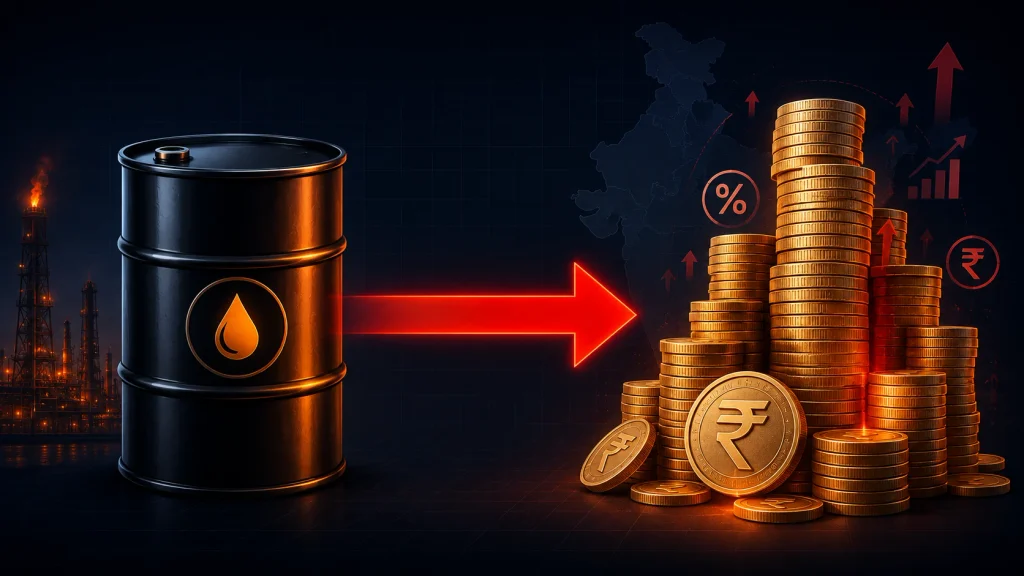
Here’s the blunt reality most casual investors underestimate: India imports over three-fourths of the crude oil it uses. That single fact is the entire reason West Asia tensions translate so directly and so quickly into Indian stock market pain.
The math isn’t abstract, either. Analysts have long calculated that a $10 increase in the price of crude oil pushes up India’s monthly import bill by roughly $1.5 billion, and adds about 0.4 percentage points to headline inflation. With Brent having climbed from the high $80s to nearly $96 in a matter of days, that’s not a rounding error — that’s a genuine, quantifiable hit to India’s trade deficit and inflation trajectory, landing at the exact moment the economy was supposed to be celebrating its growth numbers.
Who’s Actually Getting Hurt — and Who’s Winning
The selloff wasn’t evenly spread. Some of the session’s biggest laggards on the Sensex included InterGlobe Aviation (IndiGo), Eternal, Mahindra & Mahindra, UltraTech Cement, Bajaj Finserv, and Bajaj Finance — a mix that makes intuitive sense once you think it through: airlines get hammered by rising fuel costs, cement and auto names get squeezed by higher input and logistics costs, and financials get nervous about rate and inflation pressure.
Meanwhile, Adani Ports and Sun Pharma were among the rare gainers in an otherwise brutal session — a reminder that even in a broad-based selloff, sector-specific dynamics still create pockets of relative strength.
Unsurprisingly, oil & gas stocks themselves actually gained even as the broader Nifty fell — a classic, predictable rotation where rising crude prices hurt oil consumers but help oil producers and explorers.
It’s Not Just Oil — Bond Yields Are Piling On Too
Crude isn’t acting alone here. Global bond yields have been rising in tandem, with the yield on India’s 10-year benchmark government bond climbing to 6.975%, and the US 10-year yield rising to 4.812%. A “global bond selloff” was explicitly cited as intensifying pressure on equities across both European and Asian markets on the same day.
Higher yields make bonds more attractive relative to stocks, push up borrowing costs for companies, and generally signal that investors are demanding more compensation for risk — exactly the wrong combination when you’re already nervous about inflation from an oil shock.
The One Genuinely Reassuring Data Point
Here’s something worth holding onto amid the gloom: Foreign Institutional Investors actually bought Indian equities worth ₹1,143.38 crore in the session just before this steepest leg of the selloff. That’s a meaningful signal — it suggests this isn’t (yet) a story of foreign capital fleeing India outright, but rather a broad, sentiment-driven repricing tied specifically to the oil and yield shock, not a fundamental loss of confidence in India’s growth story.
What Analysts Are Actually Saying
Ponmudi R, CEO of online trading and wealth-tech firm Enrich Money, identified crude oil as the principal short-term threat to Indian equities right now — not valuations, not earnings, not domestic policy. Just oil.
V K Vijayakumar, Chief Investment Strategist at Geojit Investments, echoed the same read, calling the escalation and the overnight surge in Brent toward $96 “negative for market sentiment” in no uncertain terms.
When two analysts from different firms independently zero in on the exact same single variable, that’s usually a sign the market genuinely has one dominant story right now, not a tangle of competing narratives.

The Bigger, Uncomfortable Pattern
If this sequence of events feels oddly familiar, that’s because it is. India’s stock market has been here before, repeatedly: Sensex fell sharply in October 2023 when Brent spiked past $93 after Middle East violence. It happened again in April 2024. Again in October 2024, with the Sensex plunging over 1,500 points in a single session. And now, again, in September 2026.
The pattern is remarkably consistent: escalation in West Asia → crude spikes → Indian equities sell off broad-based → analysts point to the same import-dependency math every single time. It’s less a series of isolated shocks and more a recurring structural vulnerability that resurfaces every time geopolitical tension flares in the region that supplies so much of India’s energy.
So, What Does This Mean for You?
If you’re an Indian investor watching your portfolio redden right now, here’s the grounded, non-panicked way to think about it:
- This is a macro, geopolitical shock, not a company-specific or India-specific fundamental problem. The GDP number tells you the underlying economy is genuinely strong.
- Sector selection matters more than usual right now. Aviation, cement, autos, and rate-sensitive financials are feeling this acutely; oil & gas and select defensive names are relatively insulated or even benefiting.
- Watch FII flow data closely. As long as foreign investors keep buying even through the volatility, that’s a meaningfully different (and less alarming) situation than a genuine capital-flight scenario.
- This has happened before, and markets have recovered before. That’s not a guarantee about this specific episode, but it is useful historical context for not overreacting to a single volatile week.
The Bottom Line
India just proved, once again, that even a genuinely excellent domestic growth story can’t fully insulate its stock market from a geopolitical oil shock thousands of miles away. With Brent crude pushing toward $96, bond yields climbing globally, and every major sectoral index in the red, this is a moment where the “why” behind the market’s move matters more than the raw number itself. Keep an eye on how the West Asia situation develops — because based on India’s own recent history, that’s genuinely the variable that will decide whether this is a rough week or the start of something longer.
FAQs
Why do West Asia tensions affect the Indian stock market so much?
India imports more than three-fourths of its crude oil requirements, so rising oil prices during Middle East conflicts directly increase India’s import bill, worsen inflation, and widen the trade deficit — all of which weigh heavily on investor sentiment and equity prices.
How much does a $10 rise in oil prices actually cost India?
Analysts estimate a $10 increase in crude prices adds roughly $1.5 billion to India’s monthly import bill and around 0.4 percentage points to the headline inflation rate.
Which sectors are hit hardest when oil prices spike?
Aviation (due to jet fuel costs), cement, automobiles, and rate-sensitive financials tend to underperform the most, while oil & gas producers and explorers often gain as crude prices rise.
Are foreign investors pulling money out of India because of this?
Not necessarily — FIIs actually bought ₹1,143.38 crore worth of Indian equities in the session preceding the sharpest part of this selloff, suggesting the move is more sentiment-driven than a fundamental retreat from India.
Has this happened before?
Yes, repeatedly. Indian markets have sold off on West Asia-driven oil spikes multiple times in recent years, including October 2023, April 2024, and October 2024 — this September 2026 episode follows a very similar pattern.
For more real-time breakdowns of what’s actually moving Indian markets, check out more coverage on DailyTopStocks.