UPI MDR on Stocks & MFs: You’re Safe, But Your Broker’s Margins Just Got Squeezed
Here’s what the new UPI charges actually mean for your SIPs, your trades, and the apps you use to make them — decoded, with expert reactions.
If you’ve made a UPI payment for a mutual fund, a stock purchase, or an IPO application anytime in the last five years, you’ve enjoyed something genuinely rare: a world-class payment rail that cost you exactly ₹0. That changes from October 15, 2026.
The government has finally ended the zero-MDR era for UPI — the fee-free regime that’s been in place since January 2020 — and rolled out a new Merchant Discount Rate (MDR) structure. For everyday shoppers, this means a 0.4% charge on larger merchant payments. But if you’re an investor, the story is different, smaller, and honestly, a lot less scary than the headlines suggest.
Let’s break down exactly what’s changing, what experts are saying, and whether you need to do anything at all.
What’s Actually Changing on October 15
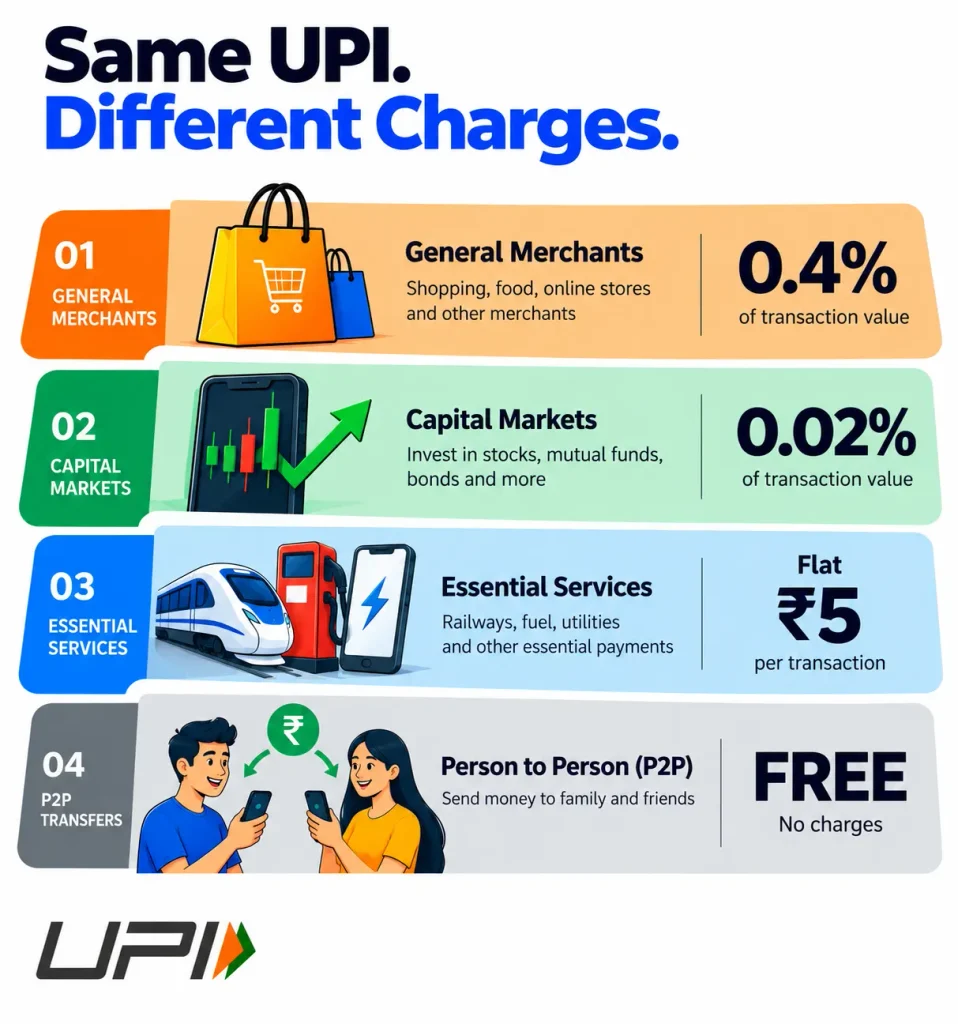
The new MDR framework isn’t one flat rate — it’s tiered by sector, and capital markets got the friendliest tier by far.
- General merchant payments: 0.4% MDR on UPI transactions above ₹2,000, capped at ₹300 for payments of ₹75,000 and above
- Capital market transactions (mutual funds, securities, stockbroker and dealer payments): a concessional 0.02% MDR, capped at ₹300 per transaction
- Essential services (railways, telecom, fuel): a flat ₹5 per transaction
- Person-to-person (P2P) UPI transfers: remain completely free, no matter the amount
- Merchant payments under ₹2,000: stay free, along with small-merchant transactions covered under the existing zero-MDR carve-out
According to the Finance Ministry, roughly 96% of all merchant (P2M) UPI transactions will be unaffected by the new charges altogether. Capital markets specifically got a rate 20x lower than the standard merchant rate — a clear signal that policymakers wanted to protect retail investor participation while still ending the blanket subsidy.
The Math: What ₹20 Actually Looks Like
Here’s the part that should calm most investors down immediately:
| Transaction Value | MDR (0.02%) | You Pay |
| ₹5,000 | 0.02% | ₹1 |
| ₹25,000 | 0.02% | ₹5 |
| ₹1,00,000 | 0.02% | ₹20 |
| ₹15,00,000+ | Capped | ₹300 (max) |
Even on a hefty ₹15 lakh lump-sum investment, you’re capped at ₹300 — less than the price of a large pizza. And if your SIP runs through UPI AutoPay or a UPI Mandate rather than a manual one-time payment, NPCI has clarified it won’t attract any MDR at all, since recurring mandate-based debits sit outside the new pricing structure.
So Who Actually Feels This?
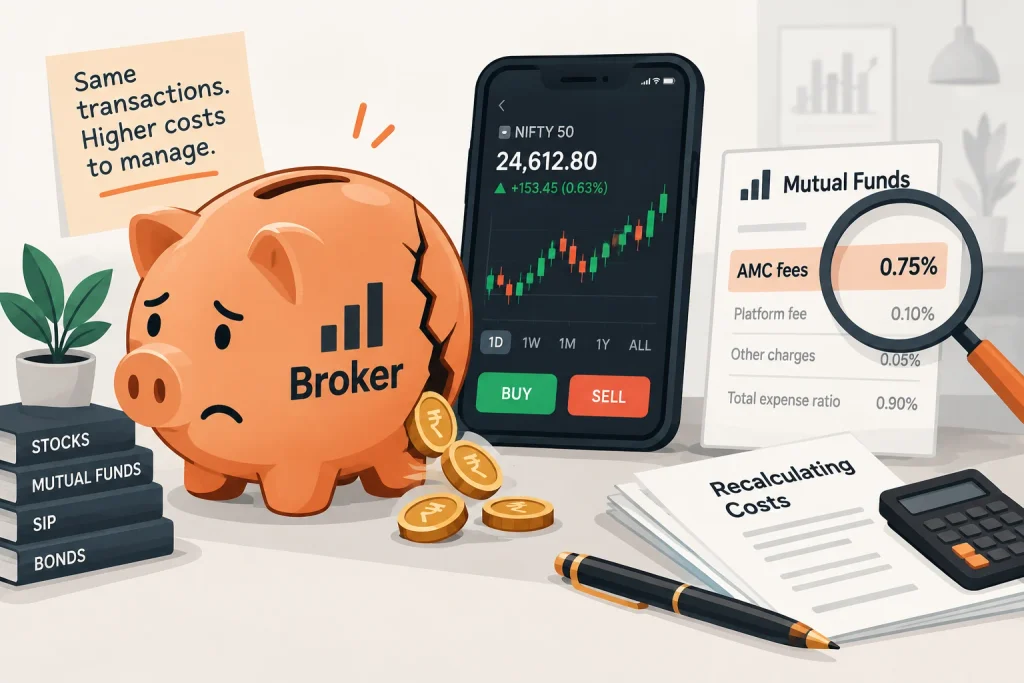
Not you — mostly, it’s your broker or investment platform.
Zero-commission platforms like Zerodha and Groww built their entire business model around thin-to-zero transaction margins, subsidized by a free payment rail. Multiply even ₹20 by the crores of UPI transactions processed monthly across India’s investing population, and it stops being pocket change for these platforms — it becomes a real line item.
What brokers are likely to do about it:
- Lean harder on account-opening fees and Annual Maintenance Charges (AMC) to offset the new cost
- Nudge active traders toward alternate payment rails (net banking, IMPS) for high-frequency transactions
- Absorb the cost quietly for retail SIP investors, where volumes and per-transaction value are small enough that it’s not worth the reputational risk of passing it on
- Watch how competitors price this first before making a public move — nobody wants to be the first platform seen “charging” loyal investors
What Experts Are Saying
The reaction from analysts and academics has been sharply divided — practical near-term optimism on one side, structural concern on the other.
On the market impact, one market analyst noted that MDR on UPI could dent trading volumes routed through UPI in the short term, but expects the effect to stabilise over time. The near-term pain, analysts say, is more likely to show up in frequent trading-related payments than in long-horizon investment flows like SIPs — active traders who move money in and out often will feel this more than someone quietly investing every month.
On fintech stocks, the market’s reaction has already played out in real time. Shares of Paytm and One Mobikwik dipped in the days around the announcement as investors weighed how the broader MDR regime (not the capital-markets carve-out specifically) might affect these companies’ UPI-dependent business models. One market participant pointed out that UPI currently generates no meaningful direct revenue for these platforms today, so the calculus around any future fee framework — even a small one — matters disproportionately to how these stocks are valued.
On the policy itself, the sharpest pushback has come from academia. Prasanna Tantri, Associate Professor of Finance at the Indian School of Business, publicly criticised the move, calling UPI “a world-class Indian innovation” and arguing that ending its zero-cost model isn’t how effective industrial policy is run. His view: infrastructure with such a large positive spillover for the economy deserved continued support, not a rollback.
Not everyone agrees, of course — plenty of voices in the banking and fintech industry have argued for years that a completely free payment rail was never commercially sustainable at UPI’s scale, and that some cost recovery was inevitable.
What This Means for You, Practically
- If you invest via SIP AutoPay/Mandate: Nothing changes. You’re exempt.
- If you make manual lump-sum UPI payments for mutual funds or stocks: Expect a near-invisible charge — a few rupees to a max of ₹300, and even then, only if your broker chooses to pass it on rather than absorb it.
- If you’re an active intraday or F&O trader who tops up your broker wallet frequently via UPI: this is the group most likely to notice a cumulative effect over a month, even if each individual charge is small.
- If you hold or are tracking fintech stocks like Paytm, MobiKwik, or payment-focused platforms: keep an eye on how they message this in their next earnings call — the framing of “revenue opportunity vs. cost pressure” will differ sharply between UPI-heavy consumer apps and capital-markets-focused platforms.
There’s no need to change your investment strategy, switch platforms, or panic-sell fintech stocks based on this alone. This is a payments-infrastructure policy shift — not a tax on your wealth, and not a reflection of investment risk or returns.
FAQ’s
What is UPI MDR?
MDR stands for Merchant Discount Rate — a small fee charged to merchants (not directly to you) for processing a digital payment. UPI has operated on a zero-MDR basis since 2020; that changes from October 15, 2026.
Will I have to pay extra for my mutual fund SIP?
No, if your SIP runs through UPI AutoPay or a UPI Mandate. These recurring, pre-authorised transactions are exempt from the new MDR entirely.
What’s the MDR rate specifically for stocks and mutual funds?
0.02% of the transaction value, capped at ₹300 per transaction — significantly lower than the 0.4% standard merchant rate.
Does this apply to one-time UPI payments for buying stocks or funds?
Yes. A one-time manual UPI payment for an equity purchase, mutual fund investment, or broker wallet top-up can attract the 0.02% capital-markets MDR.
Will Zerodha, Groww, and other brokers pass this cost on to me?
Banks have been directed not to allow merchants to pass MDR charges directly onto customers. In practice, brokers may instead adjust indirect costs like AMC, account fees, or per-order charges — but this isn’t guaranteed or immediate.
Is person-to-person (P2P) UPI still free?
Yes, completely — regardless of the amount, P2P transfers are unaffected by this change.
Should I stop using UPI for investing and switch to net banking or NEFT?
Not necessary for most investors. The cost difference is negligible for typical SIP or lump-sum amounts. It may be worth reconsidering only if you’re a high-frequency active trader moving large sums often.
How does this affect fintech stocks like Paytm and MobiKwik?
These are more exposed to the broader 0.4% merchant MDR on consumer/retail payments than to the capital-markets carve-out. Their stock prices have already shown some sensitivity to MDR-related news, so this remains a space to watch, not react to.
When exactly does this take effect?
October 15, 2026.
Stay tuned to DailyTopStocks for the latest updates on UPI MDR rules, broker reactions, and what it means for your portfolio as this story develops.
Sources: Ministry of Finance notifications, NPCI FAQs, and reporting from Business Today, The Week, and Inc42, as of September 2026.