
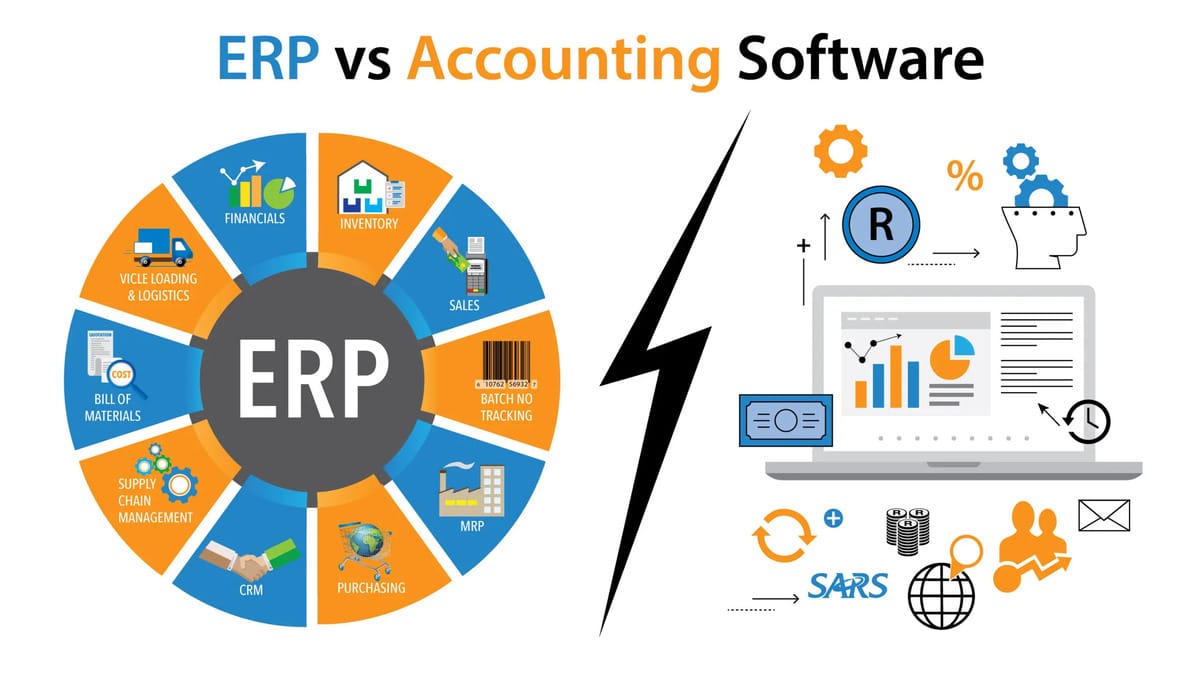
Both ERP & Accounting Software help manage a company’s finances and accounting and are often confused. That is why they sometimes interchange these terms when they are really different types of software. Knowing their differences is essential, especially if one of them is going to be implanted.
Why is it so risky to confuse them?
Mainly, because the needs of the companies may not be covered. Each tool has a different scope and functionalities.
While an ERP integrates different modules that help control and automate the processes of various areas of the company such as project management, sales or accounting, accounting software is much more limited.
Accounting software , also known as entry software, operates independently in that it uses its own database and does not integrate with other programs.
On the other hand, an ERP comprises a comprehensive solution, where the data from the different modules are collected in the same tool. In this way, efficiency can be gained in all areas of the company, not only in accounting.
What are the main differences between an ERP and an Accounting Software?
The main differences between an ERP and an Accounting Software are found in the functionalities:
Functionalities of an Accounting software
- Accounting of various companies:- It allows the management of the accounting of various companies on the same platform.
- Multiple data on the same platform: It stores customer data and allows you to create invoices, automate collections, calculate tax payments… from the manual entry of data. They also make it possible to detect errors in invoices and issue notifications.
- Ease in decision making: From these programs you can analyze the data, present tax obligations, correct errors and facilitate decision making. Of course: it only contributes to accounting decision making.
- Preparation of reports: They create an electronic record of the users who access the accounting book of the company. Managers, for their part, can review accounting audits and review information in order to correct errors and have a more accurate understanding of the accounting situation.
Functionalities of an ERP
- Multiple information: From the different modules that make it up, an ERP can provide the same accounting information as an input software plus information from the rest of the company’s areas.
- Data centralization : All the data is in the ERP and the entire accounting team can access it. In this way, work processes and productivity in companies are streamlined thanks to automation.
- Simplification of administrative processes: An ERP, from its simple interface, allows administrative processes to be more agile. From the synchronization of the data with other modules, much more complete information can be obtained.
- Automation in accounting reports: ERPs can provide accounting reports automatically. In this way, for example, the presentation of tax obligations is much simpler. The ERP is in charge of generating the corresponding files to present at the headquarters of the Tax Agency according to the established requirements.
Why choose an ERP over an Accounting Software
ERPs allow you to improve communication between the different departments of the company . In this way, the accounting activity can be enriched with information from other departments and productivity will be increased.
An accounting software does not have other modules and this means that it is limited to the accounting area. In this way, if there is data from other areas that can help streamline accounting tasks, it cannot be used centrally.
In short, an ERP increases the scope of the business. ERPs like Dynamics Business Central are scalable software that adapts to the growth of companies. They allow streamlining work processes, sales and accounting tasks.
