What Is GIFT Nifty? Why Does It Move Before the Indian Market Opens?
Ever wondered how financial channels seem to know whether the Nifty may open higher or lower before 9:15 AM? The answer usually starts with one number: GIFT Nifty.
You may have seen headlines such as “GIFT Nifty signals a gap-up opening” or “GIFT Nifty points to a weak start.” But what exactly is it, why does it trade before the Indian market opens, and how much should investors actually trust it?
Let’s break it down without the market jargon overload.
First Things First: What Is GIFT Nifty?
GIFT Nifty is a Nifty 50 index futures contract traded on NSE International Exchange (NSE IX) at GIFT City in Gujarat.
The contracts are traded and settled in US dollars, and NSE IX lists Nifty 50 futures and options among its equity-index derivatives.
But here’s the part that makes GIFT Nifty particularly interesting for Indian investors:
It keeps moving when India’s regular equity market is closed.
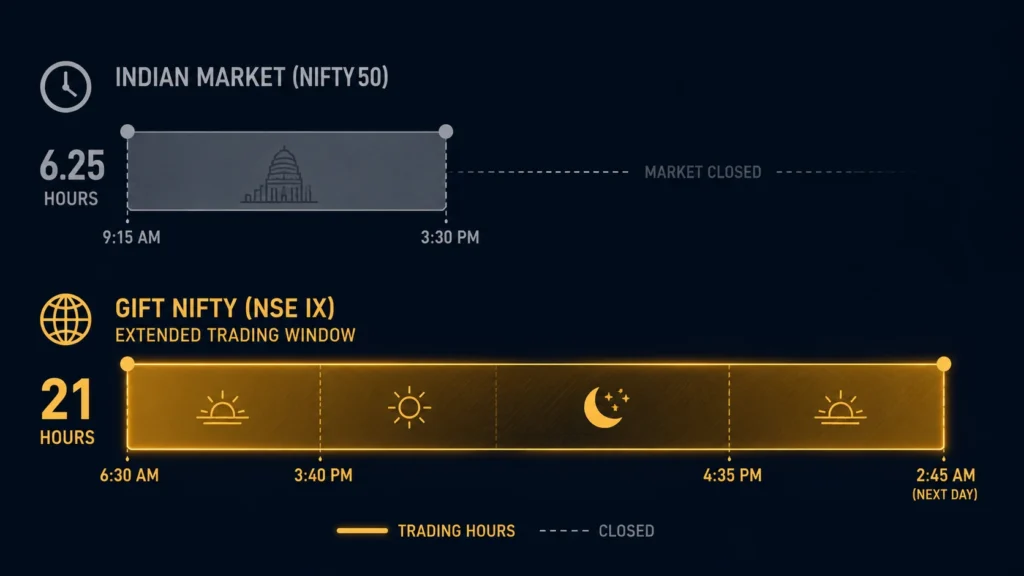
The regular NSE equity market operates during India’s normal trading session, while GIFT Nifty provides a much longer trading window.
According to NSE IX, GIFT Nifty trading runs across sessions from the early morning through the following night, with normal trading extending until 2:45 AM IST.
That extended window is the key to understanding why it has become such an important pre-market indicator.
The Market Doesn’t Sleep When India Does
Think about what happens after India’s market closes.
While Indian investors are done trading for the day:
- Wall Street continues moving.
- US economic data gets released.
- The Federal Reserve can make important announcements.
- Crude oil prices change.
- Asian markets react to overnight developments.
- Geopolitical news can break.
- The rupee and other global currencies move.
- Global investors reassess their positions.
The next morning, Indian investors need to know how all of that could affect the domestic market.
GIFT Nifty provides a live futures market where some of that information can be reflected before the NSE cash market opens.
That’s why it has become one of the first numbers traders check in the morning.
Why Is GIFT Nifty Moving Before 9:15 AM?
This is where things become really simple.
Imagine yesterday’s Nifty 50 closing level was:
24,500
Now suppose GIFT Nifty is trading around:
24,600
That’s approximately 100 points higher than the previous Nifty close.
It could suggest that traders are expecting a stronger opening.
On the other hand, if GIFT Nifty is around:
24,400
it indicates weaker sentiment and potentially points toward a lower opening.
But there’s an important catch.
GIFT Nifty does not decide where Nifty will open.
It is a futures-market signal, not a guaranteed prediction.
Domestic news, institutional flows, pre-open orders, currency movements and fresh developments can all change the actual opening price.
So don’t interpret:
GIFT Nifty +100 = Nifty will definitely open +100
Instead, think:
GIFT Nifty +100 = the futures market is currently pricing in a stronger opening bias.
That distinction matters.
A Simple Example of How the Signal Works
Let’s say:
Yesterday’s Nifty close: 24,500
Current GIFT Nifty: 24,620
Difference: +120 points
The implied signal is therefore approximately:
+120 points → possible gap-up opening
Now imagine overnight US markets suddenly fall sharply before India’s market opens.
GIFT Nifty could also fall.
Or suppose a major positive announcement arrives in India before 9:15 AM.
The actual Nifty opening could be very different from the earlier indication.
That’s why experienced traders don’t look at GIFT Nifty in isolation.
What Actually Moves GIFT Nifty?
GIFT Nifty doesn’t move randomly.
Its price reflects expectations around the future value of the Nifty 50 and can react to a wide range of global and domestic factors.
Some of the biggest triggers include:
🇺🇸 US Markets
Movements in the S&P 500, Nasdaq and Dow can influence global risk sentiment.
Federal Reserve Decisions
Interest-rate decisions and comments from Fed officials can quickly affect global markets.
Crude Oil Prices
Oil prices matter significantly to India because India is heavily dependent on imported crude.
US Dollar & Rupee
Currency movements can influence foreign investor sentiment and corporate expectations.
Asian Markets
Markets such as Japan, Hong Kong and other Asian exchanges can provide another overnight sentiment signal.
Geopolitical Events
Wars, trade restrictions, elections and unexpected global events can create sharp moves.
🇮🇳 Domestic News
Company results, RBI decisions, government announcements and major economic data can influence expectations for Indian equities.
In other words, when you see GIFT Nifty moving significantly at 7:30 or 8:00 in the morning, there’s usually a reason behind it.

Why Does GIFT Nifty Trade in Dollars?
There’s a practical reason.
NSE IX operates as an international financial market, and its products are traded and settled in US dollars.
That structure makes the market more convenient for international participants who want exposure to Indian equity derivatives without having to operate entirely through the domestic rupee-denominated market.
For a regular Indian investor watching the market, however, the dollar denomination isn’t the most important thing.
The important part is the price movement and what it may indicate about market sentiment.
🇮🇳 GIFT Nifty vs Nifty 50: What’s the Difference?
This is one of the easiest ways to understand the concept.
| GIFT Nifty | Nifty 50 |
| Futures contract | Equity index |
| Traded on NSE IX | Tracked/traded through India’s domestic market |
| USD-denominated contracts | INR-based index |
| Extended trading hours | Regular Indian market hours |
| Reflects futures-market expectations | Represents the performance of the Nifty 50 index |
| Useful for pre-market sentiment | Used to track India’s benchmark equity market |
NSE IX’s official contract specifications identify the underlying asset as the Nifty 50 Index and specify US dollars as the contract currency.
Can You Trust GIFT Nifty to Predict the Market?
Use it as a signal—not a crystal ball.
A strong GIFT Nifty reading can indicate positive sentiment, but several things can happen between that futures quote and the actual NSE opening.
For example:
GIFT Nifty: +150 points
Looks bullish.
Then, before 9:15 AM:
- A major negative headline breaks.
- Asian markets weaken.
- Crude jumps.
- The rupee falls.
- Domestic institutional flows shift.
- Pre-open orders change.
Suddenly, the expected gap-up could become much smaller—or disappear altogether.
That’s why GIFT Nifty should be considered one piece of the pre-market puzzle.
How Smart Investors Use GIFT Nifty
Instead of simply asking:
“Is GIFT Nifty green or red?”
look at the bigger picture.
Before the market opens, investors can combine:
1. GIFT Nifty
What is the futures market indicating?
2. Global Markets
What happened in the US and Asian markets?
3. FII/DII Activity
Are foreign and domestic institutions buying or selling?
4. Currency
What’s happening with USD/INR?
5. Crude Oil
Has oil moved sharply overnight?
6. Major News
Are there company-specific or macroeconomic developments?
7. Options Data
What does the options market suggest about positioning and expected volatility?
The more signals agree, the more useful the overall picture becomes.
Why the Morning GIFT Nifty Number Gets So Much Attention
There’s a psychological reason too.
Imagine waking up at 8:30 AM and seeing:
GIFT Nifty +180
Immediately, you know global sentiment is leaning positive.
But that doesn’t mean you should blindly start buying.
Instead, it tells you:
“Something has changed since yesterday’s close. Find out why.”
That is arguably the most useful way to think about GIFT Nifty.
It isn’t telling you what to buy.
It’s telling you where to start looking.
5 Mistakes Beginners Make With GIFT Nifty
1. Treating it as a guaranteed forecast
It isn’t.
2. Looking only at the number
A +100 move means little without understanding why it’s happening.
3. Ignoring global markets
GIFT Nifty itself is reacting to a broader market environment.
4. Confusing futures with the actual Nifty
They are related, but they aren’t identical instruments.
5. Making trades purely because GIFT Nifty is green
A positive pre-market signal isn’t automatically a buy signal.
So, Should You Check GIFT Nifty Every Morning?
If you actively follow Indian markets, yes—but don’t stop there.
Think of your morning routine as:
GIFT Nifty → Global markets → Overnight news → FII/DII flows → Options data → Market opening
That gives you considerably more context than simply checking whether GIFT Nifty is green or red.
And remember, the official NSE IX market itself provides live and historical information on GIFT Nifty contracts, so investors can verify the data rather than relying solely on social-media screenshots or headlines.
The Bottom Line
GIFT Nifty has become an important part of India’s pre-market conversation because it keeps trading through a much longer window than the domestic cash market.
It absorbs global developments when India’s regular market is closed and gives investors an early indication of how sentiment may look when the NSE opens.
But there’s one rule worth remembering:
GIFT Nifty predicts sentiment. It doesn’t predict the future.
Use it as an early-warning signal, understand what’s driving the move, and then combine it with other market indicators before making an investment decision.
The next time you see “GIFT Nifty up 120 points” before 9:15 AM, you won’t just know what the number means—you’ll know why the entire Indian market is watching it.
For more practical market explainers, stock insights and investor-focused coverage, explore DailyTopStocks.
FAQ’s
What is the difference between GIFT Nifty and Nifty 50?
Nifty 50 is the rupee-denominated domestic index that trades on NSE India from 9:15 AM to 3:30 PM IST. GIFT Nifty is a USD-denominated futures contract based on the same index, but it trades for roughly 21 hours a day on NSE International Exchange in GIFT City — giving it far more overlap with global market hours.
What happened to SGX Nifty?
SGX Nifty was renamed and relocated. On July 3, 2023, Nifty futures trading moved from the Singapore Exchange to NSE International Exchange in GIFT City, India, and was rebranded as GIFT Nifty as part of a formal collaboration between NSE and SGX.
What are GIFT Nifty’s trading hours?
GIFT Nifty trades in two sessions covering approximately 21 hours: Session I from 6:30 AM to 3:40 PM IST, and Session II from 4:35 PM to 2:45 AM IST the following day.
How do you calculate the expected Nifty opening using GIFT Nifty?
Subtract the previous day’s Nifty 50 closing level from the current GIFT Nifty level. For example, if GIFT Nifty is trading 100 points above the previous Nifty close, that typically signals a roughly 100-point gap-up open when Indian markets begin trading at 9:15 AM.
Can Indian retail investors trade GIFT Nifty directly?
No — GIFT Nifty is primarily designed for NRIs and global institutional investors trading through IFSC-registered brokers. Indian resident retail investors currently cannot participate directly, but can still track it as a pre-market indicator.
Is GIFT Nifty always an accurate predictor of how the market will open?
No — it’s a strong sentiment signal, not a guarantee. Domestic factors like FII-DII flows, breaking news, or RBI announcements can shift the actual opening away from what GIFT Nifty suggested overnight.
Why is GIFT Nifty traded in US dollars instead of rupees?
Dollar settlement removes currency-conversion friction for foreign institutional investors and offers tax advantages, including zero Securities Transaction Tax, under the IFSC regulatory framework — making it more attractive for global funds trading Indian equity exposure.
What is the best time to watch GIFT Nifty for pre-market cues?
The window between 8:00 AM and 9:15 AM IST is considered the most reliable, since GIFT Nifty has absorbed a full overnight cycle of global news by then, but Indian markets haven’t opened yet to add domestic noise to the signal.