What Is FII and DII, and Why Do They Move the Market More Than You Do?
Every evening, you’ll probably see the same line flash across Indian financial news: “FIIs sold ₹X crore, while DIIs bought ₹Y crore.” Most retail investors glance at it and move on.
But here’s the thing: those two numbers can tell you a lot about why the market moved that day—and where the real buying and selling power is coming from.
So, what exactly are FII and DII? Why do they have such a huge influence on the Nifty and Sensex? And why has the balance between foreign and domestic investors started changing so dramatically?
Let’s break it down without the financial jargon overload.
What Do FII and DII Actually Mean?
FII stands for Foreign Institutional Investor. These are large overseas investment institutions that put money into Indian stocks and other securities. Think global investment giants such as Morgan Stanley, BlackRock, Goldman Sachs, Vanguard, and JPMorgan Asset Management.
Technically, SEBI replaced the term FII with Foreign Portfolio Investor (FPI) under the SEBI (Foreign Portfolio Investors) Regulations, 2014. However, “FII” is still widely used in financial news and everyday market discussions.
DII stands for Domestic Institutional Investor. These are India-based institutions that invest money in the Indian market. They include:
- Mutual fund companies
- Insurance companies
- Banks
- Pension and provident funds
The simplest way to remember it?
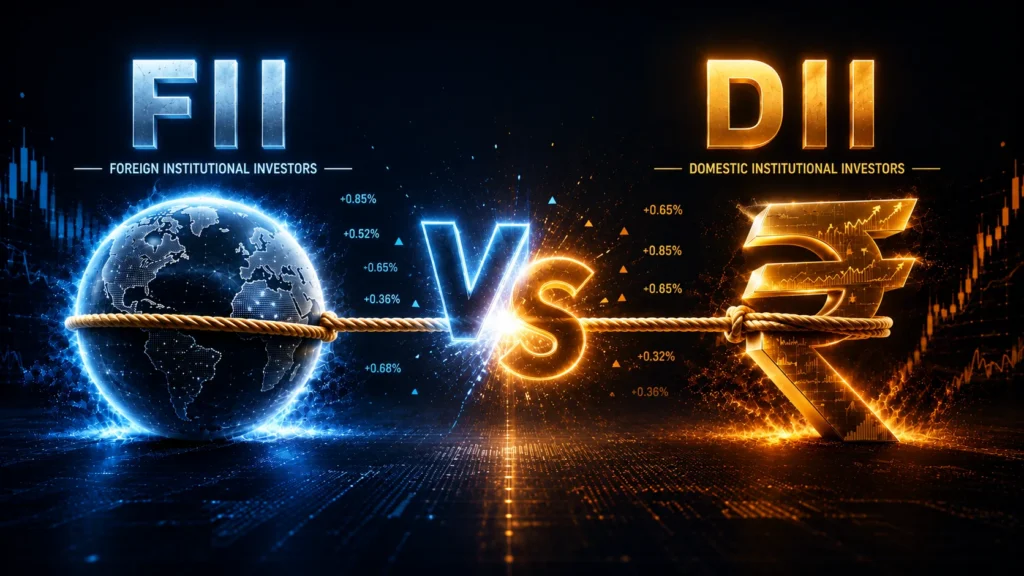
FIIs = overseas institutional money investing in India.
DIIs = Indian institutional money investing in India.
And increasingly, that second group is becoming a much bigger force.
The Big Shift Happening in Indian Markets
This is where the story gets interesting.
According to JM Financial’s Fundamental Research report, FII ownership of Indian equities fell to 14.7% of total market capitalization in the March 2026 quarter, its lowest level since 2012.
At the same time, DII ownership climbed to a record 18.9%.
That represents a remarkable structural change in the Indian equity market.
The shift was already becoming visible in September 2025. DII ownership in NSE-listed companies had reached 18.26%, while FII ownership had declined to 16.71%.
In other words, Indian institutions are no longer simply supporting the market from the sidelines. They have become one of its biggest driving forces.
₹6 Trillion vs ₹2.03 Trillion: Follow the Money
Ownership percentages are interesting, but actual cash flows make the story even clearer.
During 2025, DIIs reportedly invested around ₹6 trillion in Indian equities, while FIIs recorded approximately ₹2.03 trillion in outflows.
Think about what that means.
Foreign investors were pulling significant amounts of money out of Indian stocks, but domestic institutions were stepping in with substantially greater buying power.
That helps explain why Indian markets have shown more resilience during periods of heavy foreign selling than they did in the past.
A decade ago, large-scale FII selling could create much stronger selling pressure. Today, domestic institutional buying can act as a powerful counterweight.
But Where Is All This DII Money Coming From?
Here’s the part many retail investors miss.
A significant portion of DII strength ultimately comes from retail investors themselves.
Millions of Indians now invest through mutual funds and SIPs every month. Someone investing ₹500, ₹2,000, or ₹5,000 through an SIP might feel like a tiny participant in the stock market.
Collectively, however, millions of those contributions become enormous.
Domestic mutual funds’ ownership of Indian equities reached 10.9% by September 2025, up from 9.93% just six months earlier.
So, indirectly, retail India is becoming an increasingly important source of institutional buying power.
Your SIP may not move the Nifty by itself—but millions of SIPs moving together certainly can influence the market.
So Why Does FII Selling Still Shake the Market?
If DIIs are buying so aggressively, why does everyone still panic when FIIs start selling?
Because not all stocks have the same impact on an index.
FIIs have significant exposure to some of India’s largest and most heavily weighted companies. When institutional selling hits companies such as HDFC Bank, Reliance Industries, Infosys, or ICICI Bank, the impact can be much larger than selling in a smaller stock.
That’s because these heavyweight companies have substantial influence on indices such as the Nifty 50.
So you can have a situation where:
FIIs sell heavily → heavyweight stocks fall → Nifty comes under pressure
while simultaneously:
DIIs keep buying → broader selling pressure gets absorbed → the decline becomes less severe.
That distinction is crucial.
Why Are FIIs Selling?
FII selling isn’t necessarily a vote against India.
Foreign investors constantly compare markets around the world. Their decisions can be influenced by:
- US interest rates
- Dollar strength
- Global bond yields
- Geopolitical tensions
- Emerging-market risk
- Indian stock valuations
- Global economic growth expectations
When global risk appetite falls, FIIs can quickly move money from emerging markets toward assets they consider safer or more attractive.
DIIs, meanwhile, often have a more domestic investment horizon and receive relatively steady inflows from mutual funds, insurance and pension products.
That’s why FII flows can be more volatile, while DII buying can be comparatively consistent.
The DII Buying Wall Isn’t Risk-Free
It would be easy to look at rising DII ownership and conclude that Indian markets have become almost immune to major corrections.
That would be a mistake.
1. SIPs Can Slow Down
The strength of domestic institutional buying depends heavily on continued money flowing into mutual funds and other investment products.
If a major economic shock causes households to reduce investments or cancel SIPs, the domestic buying cushion could weaken.
2. High Valuations Can Become a Problem
More domestic buying doesn’t automatically make stocks cheap.
NSE valuation data cited for May 2026 showed median P/E ratios of around 33.3x for small caps and 37.1x for mid-caps.
At elevated valuations, even strong companies can deliver disappointing returns if earnings fail to grow quickly enough to justify their prices.
The market doesn’t always need a crash to hurt investors. Sometimes, prices simply go sideways while earnings slowly catch up.
3. Institutional Concentration Matters
As mutual fund assets continue to grow, the investment decisions of large fund managers can have an increasingly noticeable effect on individual stocks and sectors.
That creates another form of concentration risk—one that investors may not immediately notice.
What Does FII and DII Activity Mean for You?
You don’t need to track every FII and DII figure obsessively.
Instead, use the data as market context.
If the Nifty falls sharply while FIIs are aggressively selling heavyweight stocks, you have a better understanding of what may be driving the move.
If FIIs are selling but DIIs are absorbing much of that supply, it can explain why the market isn’t falling as dramatically as expected.
And if both FIIs and DIIs are buying, it tells you something very different about market sentiment.
The key is not to treat institutional flows as a simple “buy” or “sell” signal.
The Bottom Line
The Indian stock market is undergoing a major ownership transformation.
Foreign investors still matter enormously, particularly because of their exposure to large index-heavy companies. But domestic institutions now have far greater financial firepower than they did in previous market cycles.
And behind much of that DII strength are ordinary Indian investors putting money into mutual funds, SIPs, insurance and pension products.
So the next time you see “FIIs sold ₹X crore, DIIs bought ₹Y crore,” don’t just scroll past it.
Ask a better question:
Who is actually buying the market today—and who is providing the selling pressure?
Because understanding that flow can give you a much clearer picture of why the market moved, who is influencing it, and whether the move is really as alarming—or as exciting—as the headlines make it sound.
FAQ’s
What is the full form of FII and DII?
FII stands for Foreign Institutional Investor; DII stands for Domestic Institutional Investor. Since 2014, FIIs are technically classified as Foreign Portfolio Investors (FPIs) under SEBI regulations, though “FII” remains the commonly used term.
Do DIIs own more of the Indian market than FIIs now?
Yes — as of the March 2026 quarter, DII ownership reached a record 18.9% of Indian equities, surpassing FII ownership of just 14.7%, the first time domestic investors have held a larger share than foreign investors in modern Indian market history.
Why does FII selling move the Nifty more than DII buying offsets it?
FIIs remain heavy holders of the largest, most heavily weighted Nifty 50 stocks (HDFC Bank, Reliance, Infosys, ICICI Bank), so concentrated FII selling in those names can still move the index sharply even when DIIs are net buyers overall.
Where does DII buying power actually come from?
Largely from retail India, indirectly — record SIP inflows into mutual funds, along with steady contributions from insurance companies and pension funds, have fueled the DII buying wall.
Is rising DII ownership entirely good news for Indian markets?
Not without caveats. It reduces the severity of market crashes, but it also depends heavily on continued retail SIP inflows, and current DII buying into small/mid-caps at high valuations (33.3x-37.1x P/E as of May 2026) carries its own risk of flat future returns.
For more explainers breaking down how India’s markets actually work, check out more coverage on DailyTopStocks.