12 Stock Market Animals & Their Meanings You Should Know
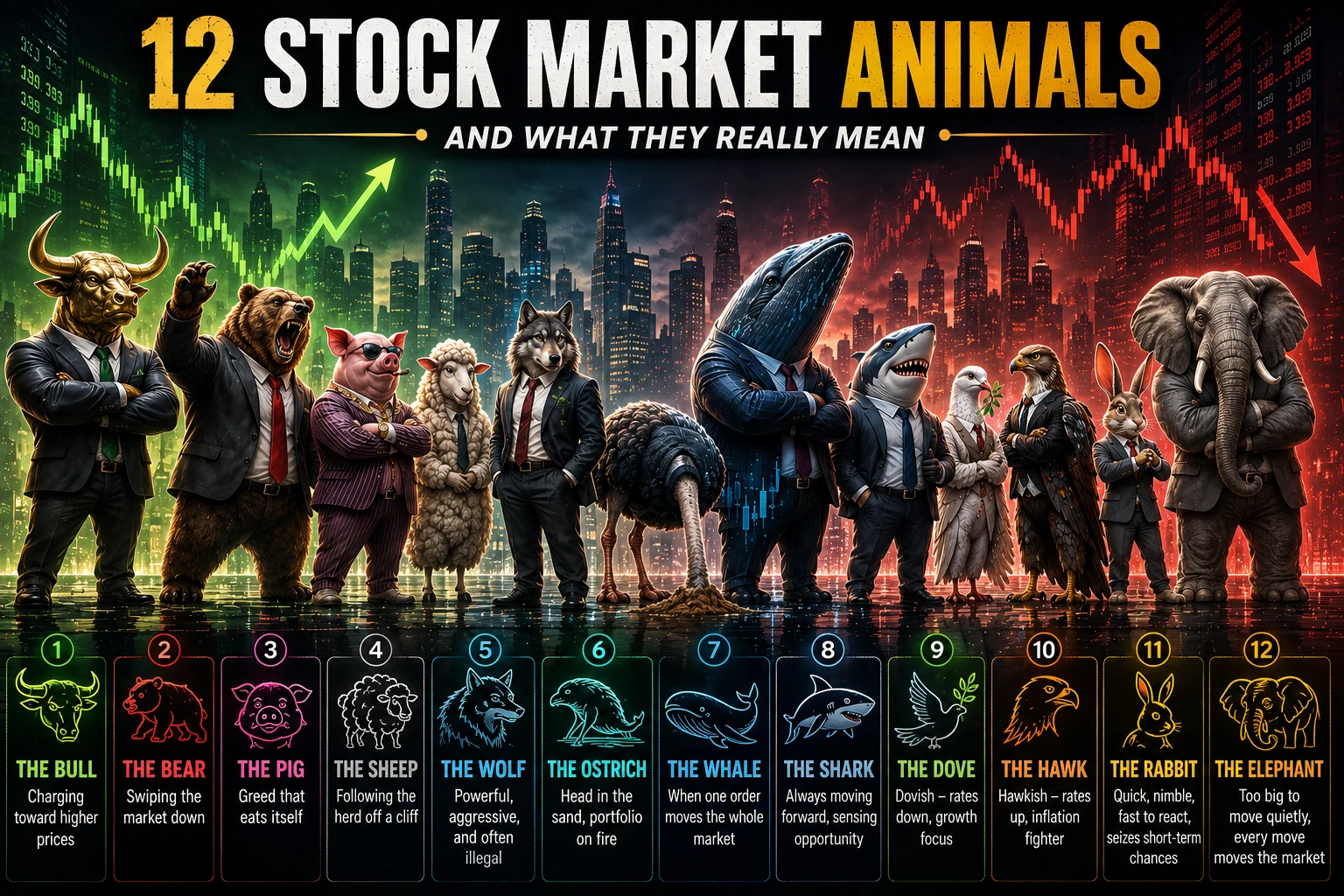
Turn on business news for the first time and you might wonder if Wall Street and Dalal Street have secretly turned into a zoo. Bulls are charging, bears are swiping, wolves are hunting, whales are making waves, and sheep are following the herd.
It sounds like a children’s fable — except these animals represent real market behavior, real money, and sometimes, real financial fraud. From the legendary bull to the dangerously passive ostrich, here are 12 stock market animals every investor should know how to spot — and the last few might reveal more about your investing personality than you expect.
1. 🐂 The Bull — Charging Toward Higher Prices
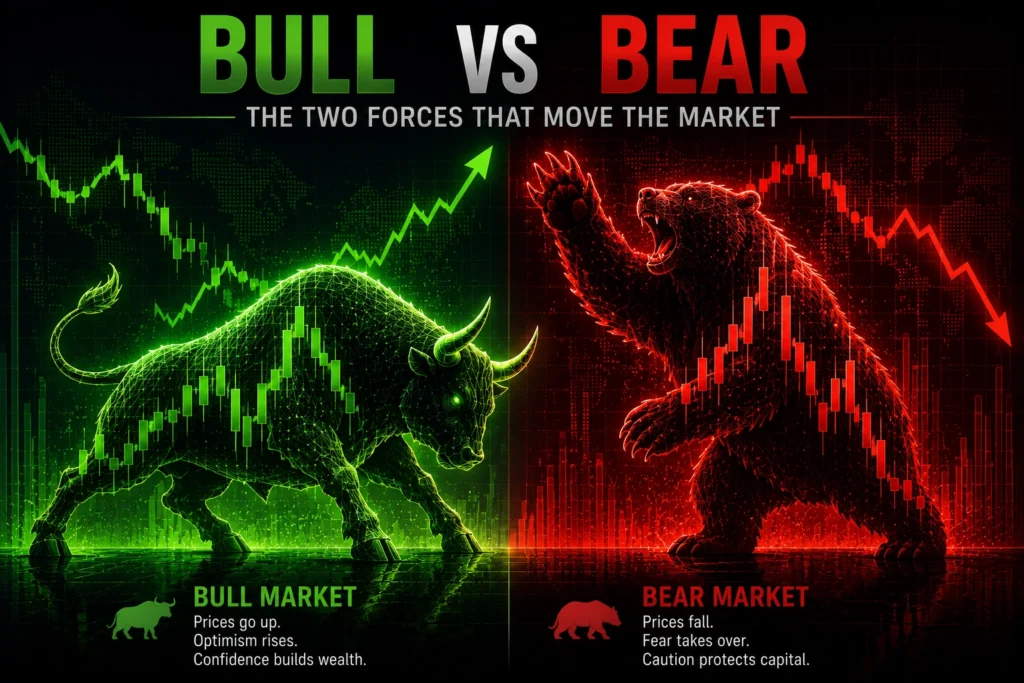
The bull attacks by thrusting its horns upward, and that single movement explains why the term “bull market” has become global shorthand for rising prices, optimism, and strong investor confidence. A bull market is typically defined as a sustained climb of 20% or more from recent lows.
India has its own legendary bull — although the story is far from flattering. Harshad Mehta, popularly remembered as the “Big Bull of Dalal Street,” became famous for the massive stock rally he engineered in 1991-92 using fraudulent bank receipts. The scheme was eventually exposed as India’s biggest securities scam of its time.
The lesson: Bulls represent confidence and rising markets — but unchecked confidence can quickly become dangerous.
2. 🐻 The Bear — Swiping the Market Down
If the bull pushes prices upward, the bear does the opposite. The bear swipes its paws downward, which is why a bear market represents falling prices, pessimism, fear, and sustained selling pressure.
A bear market is officially defined as a 20% or greater decline from recent highs. When investors become increasingly pessimistic and selling accelerates, the bear takes over the market — and suddenly, optimism can disappear faster than expected.
Bull = upward momentum. Bear = downward pressure. These are the two animals every investor encounters first.
3. 🐺 The Wolf — Powerful, Aggressive, and Often Illegal
You’ve probably heard this one even if you’ve never traded a stock. Jordan Belfort, the real-life stockbroker behind The Wolf of Wall Street, pleaded guilty to securities fraud after his brokerage marketed penny stocks while systematically defrauding investors.
In market language, the wolf represents an aggressive, powerful player willing to use highly risky or unethical tactics to make money. And India has its own obvious connection: Harshad Mehta can wear the wolf label alongside his famous “Big Bull” identity.
The warning: Aggression can create enormous gains — but when ethics disappear, the consequences can be enormous too.
4. 🐋 The Whale — When One Order Moves the Whole Market
A whale is a large, often anonymous investor whose trades are big enough to influence a stock’s direction — sometimes dramatically. Think hedge funds, FIIs, and domestic institutional investors.
In India, FIIs and DIIs can play this role because their transactions are so large that they can influence individual stocks, sectors, and even overall market sentiment in a single trading session.
Retail investors may watch a stock move sharply with no obvious news attached. Sometimes, the whale just moved.
5. 🦌 The Stag — In and Out Before You Even Notice
The stag isn’t interested in marrying an IPO for the long term. A stag applies for IPO shares purely to flip them for a quick profit when trading begins, with little or no intention of holding the stock for the long term.
This behavior is commonly called “stagging.” It is also closely associated with Grey Market Premium (GMP) speculation before a listing.
But there’s an important distinction investors should remember: GMP is an unofficial indicator. It is not recognized by SEBI or the stock exchanges. So while GMP can influence expectations around a listing, it shouldn’t automatically be treated as a guaranteed prediction of what will happen after the stock starts trading.
6. 🐷 The Pig — Greed That Eats Itself
The pig is the investor who simply wants more. More profit, more risk, more excitement, more — even when the warning signs are obvious.
Pigs typically chase hot tips, take excessive risks, act impatiently, and become obsessed with making quick money. Many market commentators treat the pig, the sheep, and the ostrich as three of the most self-defeating patterns retail traders fall into — not because of bad luck, but because of behavior they could control.
And the biggest problem? Greed rarely announces when it has gone too far. A trade that starts as confidence can quietly turn into reckless risk-taking.
7. 🪿 The Ostrich — Head in the Sand, Portfolio on Fire
The ostrich has one strategy: “If I don’t look at the problem, maybe the problem doesn’t exist.” Ostrich investors deliberately ignore danger, bad news, falling prices, or portfolio losses because facing the situation feels uncomfortable.
Behavioral economist George Loewenstein of Carnegie Mellon coined the formal term “the ostrich effect” to describe investors who avoid checking their portfolios specifically to escape bad news.
The irony? Ignoring the problem doesn’t stop the loss. It can simply give the loss more time to grow.
8. 🐑 The Sheep — Following the Herd Off a Cliff
Sheep don’t necessarily lack intelligence. They lack conviction and independent decision-making. Instead of researching a stock and forming their own opinion, sheep follow friends, family members, influencers, social media tips, market rumors, or whatever everyone else appears to be buying.
The dangerous part is timing. Sheep are often late to enter during an uptrend and late to escape during a downturn. By the time everyone is shouting “BUY,” the opportunity may already be crowded. And when everyone starts shouting “SELL,” the damage may already be done.
Following the herd feels safe — right until the herd runs in the wrong direction.
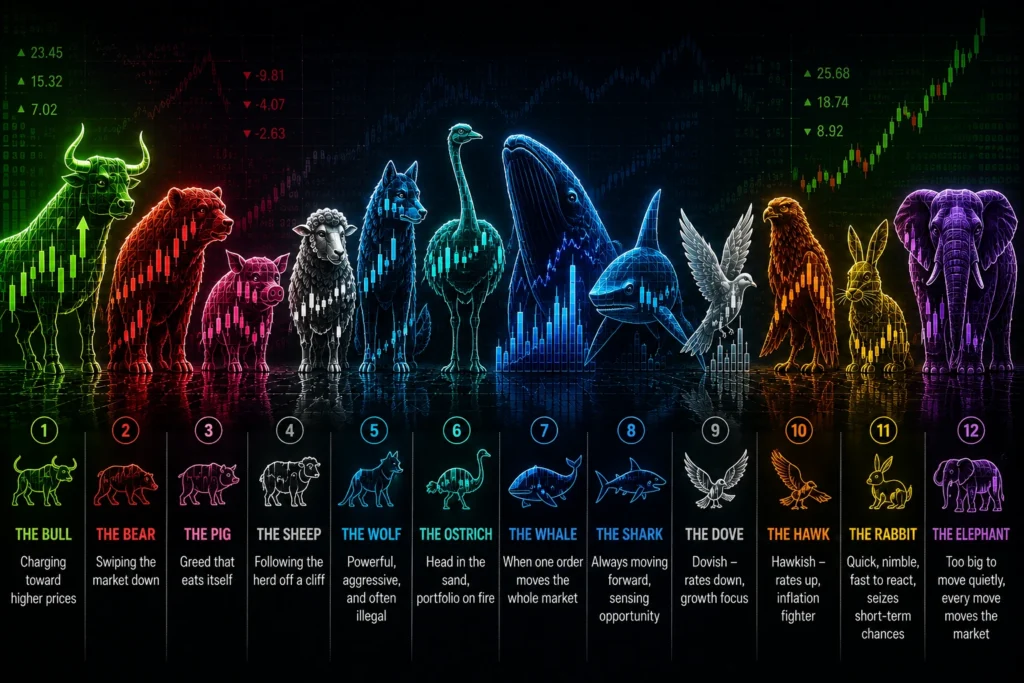
9. 🦅 The Hawk — The Inflation Fighter
Not every market animal represents investor psychology. Some describe monetary policy — and the hawk is one of two animals central banks get compared to.
A hawkish stance means a central bank, such as the RBI, favors raising or holding interest rates high to fight inflation. Hawkish signals tend to make borrowing more expensive and can pressure stock valuations, since higher rates make future company earnings worth less today.
Every RBI Monetary Policy Committee decision gets read through this lens — and a surprise hawkish tone can move bond yields and equities within minutes of the announcement.
10. 🕊️ The Dove — The Growth Supporter
The dove is the hawk’s counterpart. A dovish stance generally favors cutting interest rates, or keeping them low, to support economic growth and employment.
Dovish signals tend to be welcomed by stock markets, since cheaper borrowing costs and looser monetary policy generally support higher valuations and increased spending.
Hawk = inflation fighter. Dove = growth supporter. When the RBI changes its tone from one to the other, markets listen — and often move fast.
11. 🐈 The Dead Cat — A Bounce That Isn’t Really Alive
The name sounds ridiculous. The concept isn’t.
A dead cat bounce describes a brief and temporary recovery in price during a broader downtrend. The famous expression is based on the idea that even a dead cat will bounce if it falls from a great enough height.
In other words, a short-term recovery doesn’t necessarily mean the underlying trend has reversed.
The term dates back to December 1985, when Financial Times journalists described a brief Singapore-Malaysia market rebound — one that fell straight back into decline shortly after.
Crypto has offered several textbook examples of this pattern too. Bitcoin’s swings through late 2025 into early 2026 — sharp rallies followed by renewed sell-offs — were repeatedly flagged by traders and analysts as classic dead cat bounces rather than genuine reversals.
The takeaway? A bounce is not automatically a comeback.
12. 🐘 The Elephant — Too Big to Move Quietly
Finally, meet the heavyweight of the market menagerie.
The elephant represents a large institutional investor whose sheer size means that even a single significant trade can send ripples across the broader market. Unlike whales, which can operate anonymously, elephants are the kind of heavyweight players other investors actively watch and try to anticipate.
Why? Because when something this large changes direction, the market rarely ignores it. Their movements can influence sentiment, liquidity, and even the behavior of smaller investors trying to follow their trail.
When the elephant moves, the market notices.
So… Which Animal Are You?
Here’s the uncomfortable part. Most investors don’t spend their time being a perfect bull or bear. They’re often a pig, a sheep, or an ostrich without realizing it.
The bull and bear describe the market. The pig, sheep, and ostrich describe the investor. And that’s where these animal labels become more than clever financial terminology.
Are you chasing every hot stock because you want quick profits? That’s the pig. Are you buying because everyone on social media is buying? That’s the sheep. Are you avoiding your portfolio because you don’t want to see the losses? That’s the ostrich.
The smartest investor isn’t necessarily the biggest bull or the most aggressive wolf. It’s the investor who knows which animal is taking control — and knows when to stop it.
FAQ’s
What’s the difference between a bull market and a bear market?
A bull market is a sustained rise of 20%+ from recent lows, driven by optimism. A bear market is a sustained fall of 20%+ from recent highs, driven by pessimism.
Who is known as the “Big Bull of Dalal Street”?
Harshad Mehta, for the stock rally he engineered in 1991-92 using fraudulent bank receipts — later exposed as India’s biggest securities scam at the time.
What does it mean when a market has a “dead cat bounce”?
A dead cat bounce is a brief, short-lived price recovery during a longer downtrend, after which the decline typically resumes.
What’s the difference between a whale and an elephant in the stock market?
Both describe large, market-moving investors, but whales often operate anonymously (frequently linked to hedge funds), while elephants are typically well-known large institutional players whose trades are closely watched by others.
Are hawks and doves related to individual stocks?
No — hawkish and dovish describe central bank interest-rate stances (like the RBI’s), not individual stock behavior. A hawkish stance favors higher rates to control inflation; a dovish stance favors cutting rates to support growth.
For more explainers breaking down the language of the market, check out more coverage on DailyTopStocks.