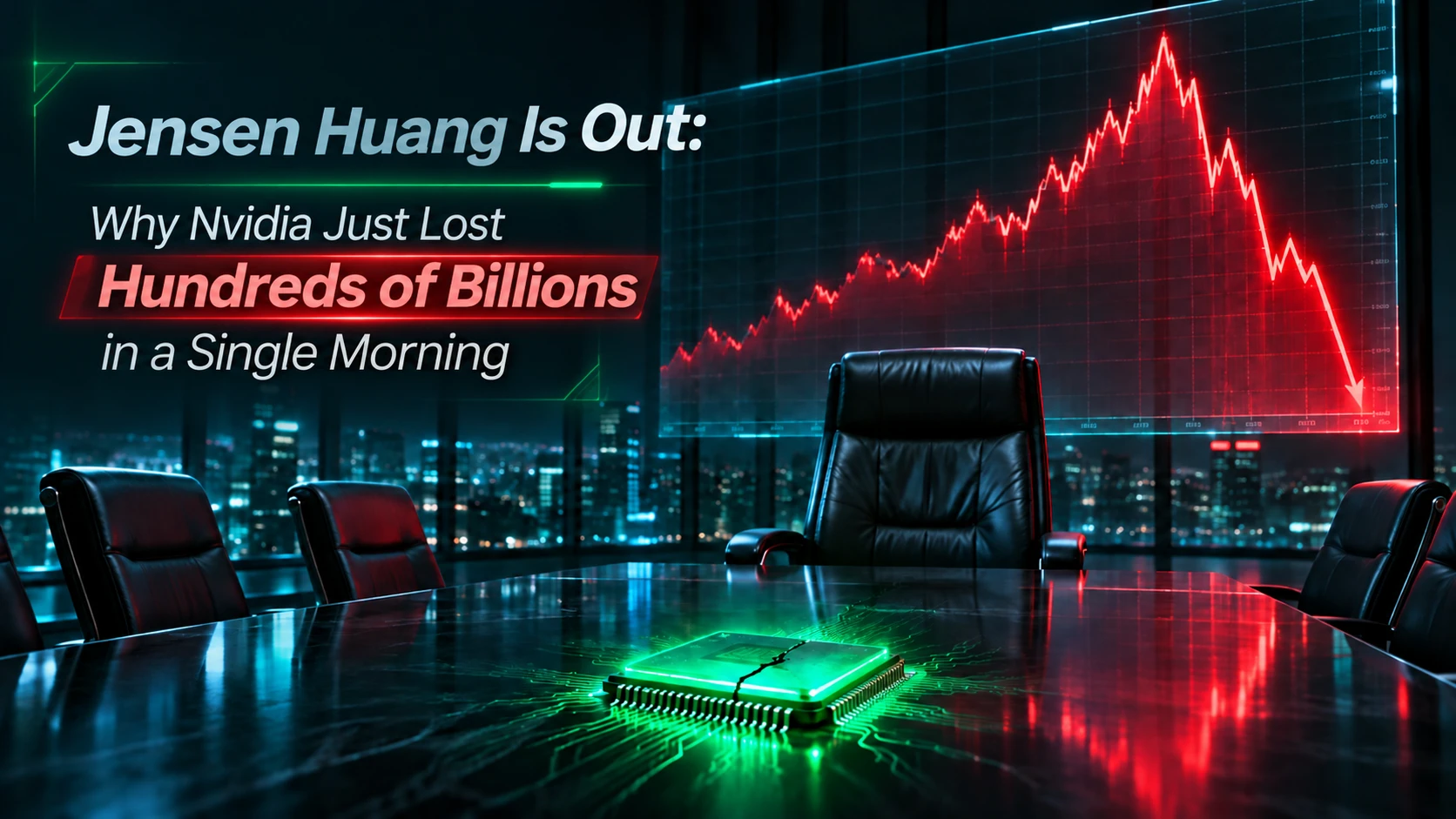
Jensen Huang Is Out: Why Nvidia Just Lost Hundreds of Billions in a Single Morning
One press release. One morning. Hundreds of billions of dollars in market value, gone.
On Thursday, November 12, 2026, Nvidia announced that co-founder Jensen Huang, the face of the AI boom and the man who led the company for 33 years, had resigned with immediate effect. Within hours, the world’s most watched chip stock was in free fall, and AI-linked stocks around the globe were feeling the shock.
Here is what happened, why the market reacted so violently, and what investors should watch next.
The Announcement That Stunned Wall Street
Nvidia’s board said Huang had stepped down as president, CEO and member of the board, effective immediately. CFO Colette Kress, who has been with the company since 2013, was named interim CEO and will keep her finance role while the board searches for a permanent successor, looking at both internal and external candidates. The board also named Harvey C. Jones as its first-ever chairman.
The board’s message was calm: it expressed full confidence in Kress and the leadership team and said operations, customer commitments and the product roadmap should continue without interruption. Kress said she was committed to building on the foundation Huang created.
The market was not in a calming mood.
How Did We Get Here? A Week That Unraveled Fast
The resignation did not come out of nowhere. It followed days of mounting pressure:
- May 2026: Short seller Culper Research published a lengthy report on Nvidia’s “China problem,” questioning the relationship between Huang and a Chinese businesswoman linked to Megaspeed, a major Southeast Asian chip buyer reportedly under investigation by US and Singapore authorities. Culper disclosed it holds a short position in Nvidia.
- Early November: Reports surfaced that Huang had an affair with a woman US intelligence officials suspect of ties to Chinese intelligence. Huang acknowledged the relationship in a letter to employees and apologized for being unfaithful to his wife.
- November 8-10: Nvidia’s board launched an independent investigation into the national security questions. Former acting US Attorney Joon H. Kim of the law firm Wachtell, Lipton, Rosen & Katz was appointed to lead it.
- Days before the exit: A New York Times report alleged a second relationship, this time with an Nvidia employee. US lawmakers called for Huang to step down.
- Wednesday, November 11: The Wall Street Journal reported the board was preparing to oust him. The stock slid in after-hours trading, and directors met that night.
- Thursday, November 12: Huang resigned.
It is important to note that the espionage claims and the relationship reports remain allegations. The board’s independent investigation has not published its findings, and Nvidia has not publicly linked the resignation to any specific finding. Huang has said he supports the investigation and will cooperate fully.

The Numbers: How Bad Was the Sell-Off?
The move was brutal, even by Nvidia standards:
- Shares fell more than 10% in premarket trading, dropping about $17.73 to roughly $156.
- At the opening bell the stock was down around 12.6%, near $151.
- Bloomberg reported the slide erased as much as $601 billion of market value at one point and pushed Nvidia below a $4 trillion valuation for the first time since July 2025.
- CBS News reported Nvidia was on track to lose more than $700 billion in value measured from the previous week’s close.
- Handelsblatt calculated that the stock was down roughly 19% over the week, with nearly $1 trillion in value lost.
A note on accuracy: figures moved sharply through the day. Some later reports put Thursday’s decline closer to 6% after early losses eased, so always check a live quote before quoting a number.
For context, Nvidia’s market value peaked around $5.78 trillion in early October, so the stock was already well off its highs before the scandal broke.
Why One Person Moves a Multi-Trillion-Dollar Company
Nvidia is far more than one man, but Huang was widely seen as essential to its story. Analysts had warned for months that the stock could plunge if he were forced out. After the news, several Wall Street analysts told CNBC that removing him could send shares down as much as 20%.
There are three reasons the market cares so much:
- Vision and credibility. Huang co-founded Nvidia in 1993 and became the public symbol of the AI revolution. Investors priced in his judgment on products, partnerships and strategy.
- Uncertainty at the top. An interim CEO and an open search leave questions about direction at a moment when the company is central to the entire AI supply chain.
- National security risk. Any suggestion that sensitive information or export-control compliance could be compromised makes regulators, customers and governments nervous.
The Ripple Effect Across AI and Global Markets
Nvidia sits at the centre of the AI ecosystem, so the shock did not stay in California. Global AI-linked stocks fell on Thursday. The chipmaker also finances infrastructure built around its own chips, a strategy that has already drawn scrutiny over so-called circular funding, and the crisis raises fresh questions about that model.
The damage even reached Malaysia, where YTL Power International, a company tied to the AI data-centre boom, fell more than 8% on the Bursa Malaysia, erasing over RM3 billion in market value.
Is It the End of the AI Boom? Analysts Are Divided
Not everyone sees permanent damage. TF International Securities analyst Ming-Chi Kuo framed the resignation as a “one-time clearing event” for the stock market, a painful reset rather than a collapse in demand. Nvidia has kept delivering strong revenue quarter after quarter, and its business fundamentals did not change overnight.
Others are more cautious. Analysts were already trimming price targets ahead of the company’s next earnings report, and concerns about an AI financial bubble, political backlash against data centres and funding practices were around long before this week.
What Investors Should Watch Next
- The board investigation: Its findings, and whether regulators or Congress get involved, could move the stock more than anything else.
- The CEO search: An experienced outside leader or a trusted insider could calm the market. A drawn-out search could do the opposite.
- The next earnings report: Guidance on demand, supply and China exposure will show whether the business is still on track.
- Wider AI sentiment: Watch how chip peers, cloud providers and AI infrastructure names behave as the dust settles.
The Road Ahead for Nvidia
Jensen Huang’s exit is one of the biggest leadership shocks in modern corporate history, and the market responded accordingly. Nvidia’s core business remains strong, but trust, leadership and governance are now in the spotlight. For investors, the next few weeks are about facts, not headlines: wait for the investigation’s results, watch who takes the helm, and avoid decisions based on panic.
Markets move fast and so do headlines. Stay ahead with daily stock news, market explainers and investing insights on Daily Top Stocks.
FAQs
1. Why did Huang resign, and when?
Nvidia announced his immediate resignation on November 12, 2026, after days of controversy over an alleged relationship with a woman suspected of Chinese intelligence links. The company has not given an official reason.
2. Who is interim CEO, and who chairs the board?
CFO Colette Kress is interim CEO, and Harvey C. Jones is the company’s first-ever board chairman.
3. How far did the stock fall, and how much value was lost?
The stock opened down 12.6%, at $150.99. Bloomberg said as much as $601 billion in market value was erased at one point. Some later reports showed a smaller fall of about 6%, so check a live quote.
4. Has any wrongdoing been proven, and who is investigating?
No. The claims are reports and allegations, and the board’s independent investigation has not reported its findings. It is led by Joon H. Kim of the law firm Wachtell, Lipton, Rosen & Katz.
5. What is the impact on Nvidia’s business and other AI stocks?
The board expects operations and the product roadmap to continue without interruption. Global AI-linked stocks fell too, with new scrutiny of the chipmaker’s funding of AI infrastructure.
6. Who will be the permanent CEO?
Nobody has been named yet. The board is considering both internal and external candidates.
7. Was the stock already falling?
Yes. It had lost about 30% of its value since its early-October record of $5.78 trillion.
8. Why does one CEO matter so much?
Huang co-founded Nvidia in 1993 and was the face of the AI boom. Analysts told CNBC that removing him could send shares down about 20%.